
IGF-1 LR3: The Mechanism of Muscle Hyperplasia
Learn how IGF-1 LR3 creates new muscle fibers through hyperplasia. Complete dosing protocols, stacking strategies, and safety tips for researchers.
- Published
- Updated
- Reading time
- 13 min read
- Author
- By PeptidesFinder
On this page
What if you could create entirely new muscle fibers, not just make existing ones bigger?
Most muscle growth happens through hypertrophy. That means your existing muscle cells get larger. But there is a limit to how big a single muscle fiber can grow.
IGF-1 LR3 works differently. It triggers hyperplasia, which means creating brand new muscle fibers. This is like adding more engines to a car instead of just making the existing engine bigger.
IGF-1 LR3 stands for Insulin-like Growth Factor-1 Long R3. It is a modified version of the natural IGF-1 hormone your body produces. The modifications make it last 20 to 30 hours in your bloodstream instead of just a few minutes.
Research published in PMC shows that IGF-1 increases muscle protein synthesis through a specific cellular pathway called PI3K/Akt/mTOR. At the same time, it stops your body from breaking down muscle protein.
This guide covers everything you need to know. You will learn how IGF-1 LR3 works, the right way to dose it, how to avoid side effects like low blood sugar, and how to stack it with other peptides for maximum results.
What Is IGF-1 LR3? Understanding the Modified Growth Factor
First, let us talk about regular IGF-1.
Your liver makes IGF-1 when growth hormone tells it to. IGF-1 then travels through your blood to muscle tissue where it signals cells to grow. It is called insulin-like because its structure looks similar to insulin.
But here is the problem. Your body has proteins called IGF-binding proteins that grab onto IGF-1 and deactivate it. These proteins are like a safety system that prevents too much growth. Within 12 to 15 minutes, most of the IGF-1 in your blood is neutralized.
The LR3 Modification Makes It More Powerful
Scientists created IGF-1 LR3 by making two changes to the natural IGF-1 molecule:
Change 1 (Long): They added 13 extra amino acids to one end of the peptide chain. This makes the molecule longer.
Change 2 (R3): They swapped one amino acid (glutamic acid) for a different one (arginine) at position 3.
These changes dramatically reduce how well IGF-binding proteins can grab IGF-1 LR3. According to research in MDPI Cells, this creates a peptide that:
- Stays active for 20 to 30 hours (versus 12 to 15 minutes)
- Works 2 to 3 times better at triggering muscle growth
- Reaches muscle tissue more effectively
- Sends growth signals all day long
Think of it like this. Regular IGF-1 is like sending a text message that deletes itself in 15 minutes. IGF-1 LR3 is like sending a message that stays visible all day. Your muscles get constant growth signals instead of brief ones.
Want to learn more about how peptides work? Check out our Complete Guide to Peptides.
How IGF-1 LR3 Creates New Muscle Fibers
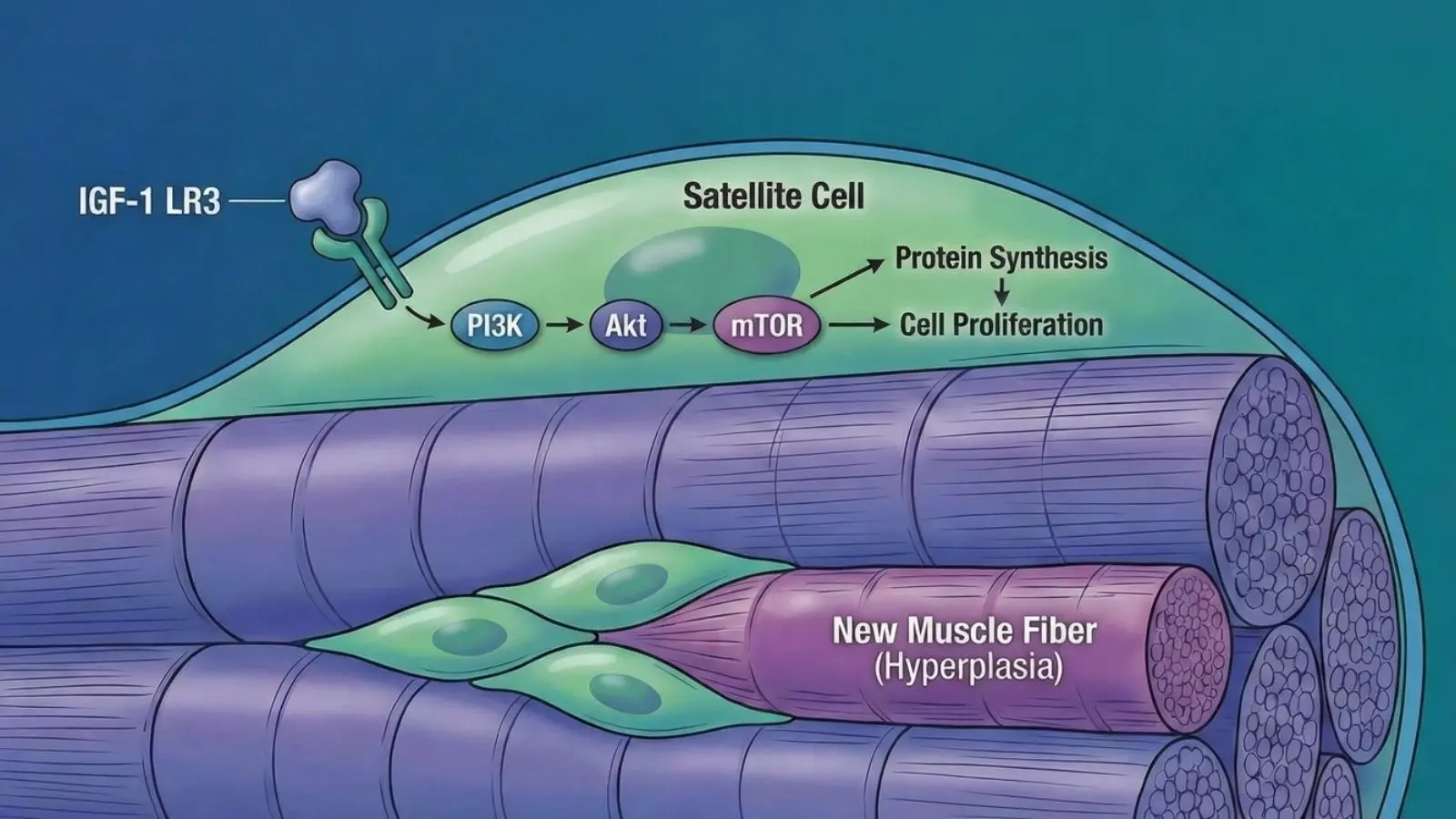
This is where things get exciting. IGF-1 LR3 does not just make your existing muscle bigger. It can actually create new muscle cells through a process called hyperplasia.
Step 1: Activating the Growth Pathway
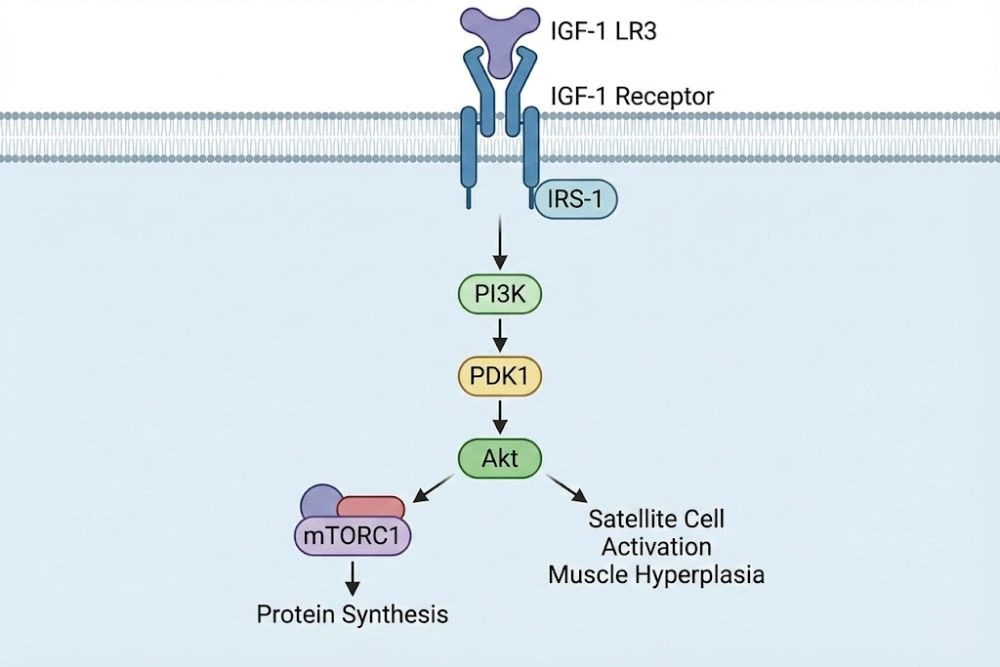
After you inject IGF-1 LR3, it travels through your bloodstream to your muscles. There, it binds to receptors on the surface of muscle cells. This binding starts a chain reaction inside the cell.
The chain reaction goes like this:
- A protein called IRS-1 gets activated
- IRS-1 activates another protein called PI3K
- PI3K activates a protein called Akt
- Akt is the master switch for muscle growth
Once Akt is turned on, two important things happen at the same time.
Step 2: Building More Protein
Akt activates something called mTOR. Think of mTOR as a factory that builds muscle protein. When mTOR is active, your muscle cells start making more of the proteins that make muscles contract and grow.
This process is called protein synthesis. It is how your muscles get bigger and stronger after training.
Step 3: Activating Satellite Cells (The Key to Hyperplasia)
Here is what makes IGF-1 LR3 special.
Your muscles contain stem cells called satellite cells. These cells normally sit dormant between your muscle fibers. But when they get the right signal, they wake up and start multiplying.
IGF-1 LR3 is one of the strongest signals for activating satellite cells. Research in PMC shows that IGF-1 makes satellite cells:
- Multiply (create more stem cells)
- Mature (turn into muscle cells)
- Fuse (merge with existing muscle or form new fibers)
When satellite cells fuse together or merge with existing muscle fibers, you get actual new muscle tissue. This is hyperplasia, not just hypertrophy.
A study on PubMed found that when researchers increased IGF-1 levels in fish muscle, the fish developed more muscle fibers, not just bigger ones. The mechanism works the same way in human muscle.
Step 4: Stopping Muscle Breakdown
Building muscle is not just about creating new protein. You also need to prevent your body from breaking down the muscle you have.
IGF-1 LR3 does this by blocking proteins that normally tag muscle tissue for destruction. When Akt is active (which IGF-1 LR3 causes), it turns off genes that break down muscle.
This anti-breakdown effect means you keep more of the muscle you build, even when you are cutting calories or training hard.
The Main Benefits of IGF-1 LR3
Now that you understand the mechanism, let us talk about what IGF-1 LR3 can actually do for you.
Benefit 1: Create New Muscle Fibers
This is the big one. While most supplements and even anabolic steroids just make your existing muscle fibers bigger, IGF-1 LR3 can help create new ones through satellite cell activation.
Here is why that matters. Each muscle fiber has a limit to how big it can get. Once you hit that limit, growth slows down. But if you have more muscle fibers, you have more capacity for growth.
Many users report that muscle gained with IGF-1 LR3 seems more permanent. That is because those new muscle cells stick around even after you stop using the peptide.
Benefit 2: Better Nutrient Partitioning
IGF-1 LR3 helps your body send nutrients to muscle instead of fat. It increases how well your muscles absorb glucose and amino acids. At the same time, it promotes fat burning.
This creates a situation where:
- Your muscles get more fuel for growth
- Your fat cells get less fuel for storage
- Your body burns more fat for energy
Users often report extreme muscle fullness, constant pumps, and visible veins even when eating normal calories. This is nutrient partitioning in action.
Benefit 3: Faster Recovery
IGF-1 LR3 speeds up recovery in multiple ways:
- It helps repair damaged muscle fibers faster
- It strengthens tendons and ligaments
- It reduces inflammation
- It decreases muscle soreness
Faster recovery means you can train the same muscle groups more frequently. More frequent training means more growth stimulus.
Many people stack IGF-1 LR3 with recovery peptides like BPC-157 for even better results.
Benefit 4: Burn Fat While Building Muscle
Because of the nutrient partitioning effect, many users lose body fat while gaining muscle mass. You do not need to be in a caloric deficit to burn fat when using IGF-1 LR3.
This is especially noticeable in stubborn fat areas like the lower abs and love handles. The increased glucose uptake in muscle combined with enhanced fat breakdown creates an ideal environment for body recomposition.
How to Dose IGF-1 LR3 Safely and Effectively
IMPORTANT: IGF-1 LR3 is measured in micrograms (mcg), NOT milligrams (mg). Getting this wrong can be dangerous.
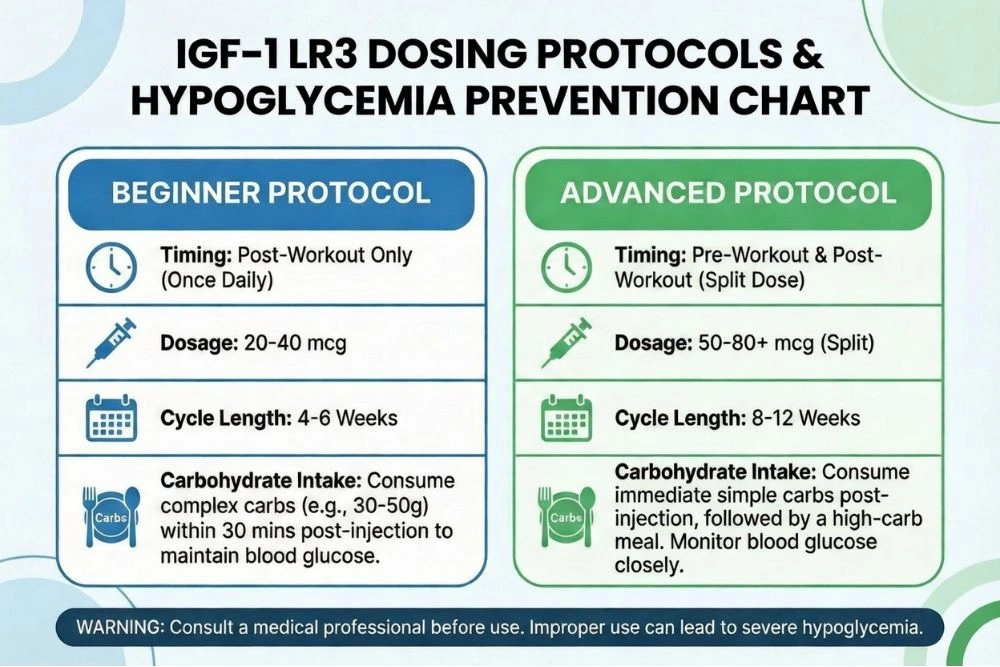
Beginner Dosing Protocol
If you are new to IGF-1 LR3, start with:
- Dose: 20 to 40 mcg per day
- Timing: Right after your workout
- Cycle length: 4 weeks on, 4 weeks off
- Injection: Under the skin in your stomach or into the muscle you just trained
Advanced Dosing Protocol
Once you know how your body responds:
- Dose: 40 to 80 mcg per day
- Timing: Post-workout for best results
- Cycle length: 5 to 6 weeks on, 6 weeks off
- Note: Rotate where you inject to avoid uneven growth
How to Mix and Store It
IGF-1 LR3 comes as a powder that you need to mix with sterile water before using. Here is how:
- Use bacteriostatic water (it has preservatives to prevent bacterial growth)
- Add the water slowly down the inside wall of the vial, not directly onto the powder
- Gently swirl the vial until the powder dissolves (never shake it)
- Store the powder in your freezer before mixing
- Store the mixed solution in your fridge for up to 2 weeks
Need help calculating exact doses? Use our Peptide Calculator.
When to Inject for Best Results
Post-workout (recommended): Inject immediately after training when your muscles are most receptive. If you inject into the muscle you just trained, you may get even better results in that specific area.
Critical safety rule: Eat 30 to 50 grams of fast carbs (like white rice, fruit, or a sports drink) within 30 minutes of injecting. This prevents dangerous drops in blood sugar.
Stacking IGF-1 LR3 with Other Peptides
You can combine IGF-1 LR3 with other peptides for even better results. Here are the most popular stacks.
Stack 1: IGF-1 LR3 + CJC-1295 + Ipamorelin
This is the ultimate muscle-building stack.
- CJC-1295 increases your natural growth hormone production
- Ipamorelin creates pulses of growth hormone without affecting cortisol
- IGF-1 LR3 provides direct muscle growth signals
Together, they work on different parts of the growth hormone system for maximum effect. Space out the injections by 2 to 3 hours.
Learn more about growth hormone peptides in our guide CJC-1295 vs. Ipamorelin: Which Growth Hormone Secretagogue is Best?
Stack 2: IGF-1 LR3 + BPC-157 + TB-500
This is the recovery and healing stack.
- IGF-1 LR3 builds muscle and activates satellite cells
- BPC-157 heals tendons, ligaments, and gut tissue
- TB-500 reduces inflammation throughout your body
Athletes recovering from injuries or surgeries often use this combination.
Stack 3: IGF-1 LR3 + MGF
This is for advanced users chasing maximum hyperplasia.
- MGF (Mechano Growth Factor) activates satellite cells right after training
- IGF-1 LR3 provides systemic growth signals all day
Some protocols use MGF post-workout on training days and IGF-1 LR3 on rest days.
For complete muscle-building protocols, check out Peptides for Muscle Growth: The Ultimate Stacking Guide
Managing Side Effects: What to Watch For
IGF-1 LR3 is powerful, which means you need to respect it and manage side effects properly.
Side Effect 1: Low Blood Sugar (Hypoglycemia)
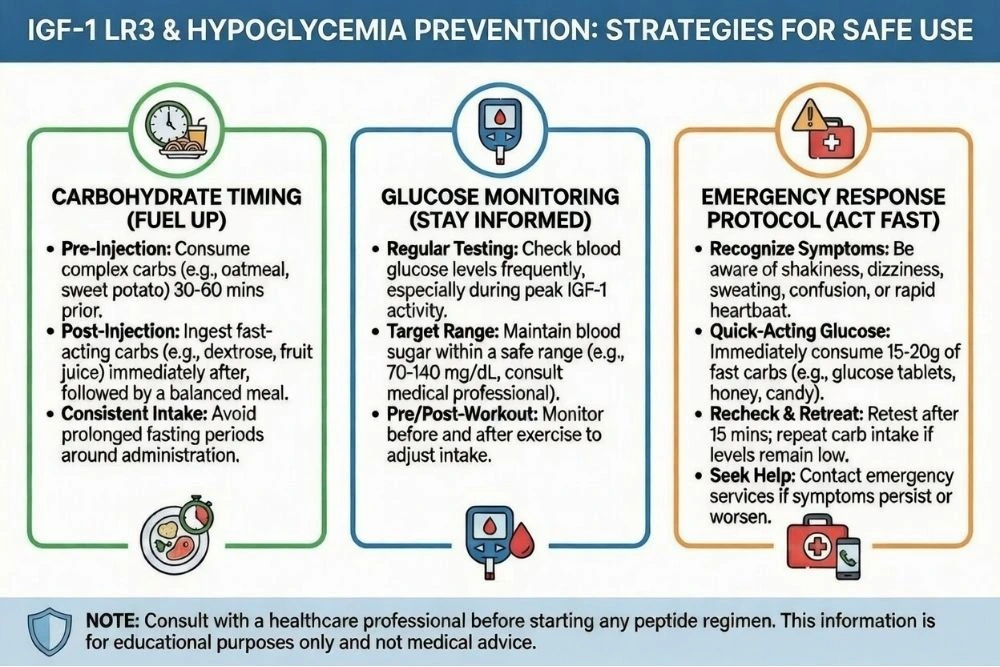
This is the main concern. IGF-1 LR3 acts like insulin and pushes glucose into your muscle cells. This can drop your blood sugar to dangerous levels.
Symptoms include:
- Shakiness and sweating
- Confusion and dizziness
- Rapid heartbeat
- In severe cases, passing out
How to prevent it:
- ALWAYS eat 30 to 50 g of fast carbs within 30 minutes of injecting
- NEVER inject on an empty stomach
- Keep glucose tablets or candy nearby
- Start with a low dose to see how your body responds
Side Effect 2: Water Retention
Some users hold extra water, especially when stacking with growth hormone peptides.
How to manage it:
- Drink more water (this actually helps reduce retention)
- Reduce sodium intake
- Lower your dose if bloating is severe
Side Effect 3: Joint Discomfort
Rapid muscle growth can cause temporary joint stiffness.
How to manage it:
- Increase stretching and mobility work
- Use foam rolling
- Add collagen peptides for joint support
Side Effect 4: Injection Site Reactions
You might get redness or soreness where you inject.
How to prevent it:
- Rotate injection sites
- Use proper sterile technique
- Massage the area gently after injecting
Getting High-Quality IGF-1 LR3
IGF-1 LR3 is sold as a research chemical. It is not FDA-approved for human use. Quality varies a lot between suppliers.
What to Look For
When buying IGF-1 LR3, make sure the supplier provides:
- Third-party lab testing (HPLC purity analysis showing 98% or higher)
- Mass spectrometry results (confirms the correct molecular weight)
- Sterility testing (proves no bacterial contamination)
- Proper vacuum-sealed packaging
- Good reputation and verified customer reviews
Learn how to read quality reports in our guide: How to Read a Certificate of Analysis.
Where to Buy Quality IGF-1 LR3
When sourcing IGF-1 LR3 for research, quality matters. We recommend verified suppliers with third-party testing and good track records.
Frequently Asked Questions
How long until I see results with IGF-1 LR3?
Most people notice increased muscle fullness and pumps within 3 to 7 days. Measurable strength gains usually appear in 2 to 3 weeks. Significant muscle growth and body recomposition typically require 4 to 6 weeks of consistent use with proper training and nutrition.
Can women use IGF-1 LR3 safely?
Yes. Unlike anabolic steroids, IGF-1 LR3 works through growth factor signaling and does not cause masculine side effects. Women typically use the same dosing protocols as men, starting at 20 to 40 mcg per day. However, it should not be used during pregnancy or breastfeeding.
What is the difference between IGF-1 LR3 and IGF-1 DES?
IGF-1 DES is a shorter version of IGF-1 (missing the first 3 amino acids) with a very short half-life of 20 to 30 minutes. It is 10 times more potent at the receptor but acts locally in the muscle you inject. IGF-1 LR3 has a much longer half-life (20 to 30 hours) and works systemically throughout your entire body. LR3 is better for overall muscle growth, while DES is used for site-specific effects.
Why do I need to cycle IGF-1 LR3?
Continuous use can lead to receptor desensitization, where your IGF-1 receptors become less responsive to the peptide. Cycling (4 to 6 weeks on, equal time off) allows your receptors to upregulate and restore their sensitivity. This maintains effectiveness and prevents diminishing returns over time.
Can I use IGF-1 LR3 just for fat loss without building muscle?
While IGF-1 LR3 does promote fat loss through better nutrient partitioning and increased fat burning, its primary mechanism is anabolic (muscle building). If you want pure fat loss without muscle gain, other peptides might be more appropriate. However, adding muscle increases your metabolism, which supports long-term fat loss.
Is IGF-1 LR3 legal to use?
IGF-1 LR3 is sold as a research chemical with the label "not for human consumption." It is not FDA-approved for any medical use. It is legal to purchase for research purposes in many jurisdictions. However, it is banned by WADA (World Anti-Doping Agency) for competitive athletes. Always check your local regulations before purchasing.
Conclusion: The Power of Creating New Muscle
IGF-1 LR3 represents one of the most powerful tools available for building muscle and transforming your physique.
Unlike most supplements and even anabolic steroids that simply make your existing muscle fibers bigger, IGF-1 LR3 works at the stem cell level. It activates satellite cells and can help create entirely new muscle fibers through hyperplasia.
This fundamental difference explains why many users report that gains made with IGF-1 LR3 appear more permanent. When you create new muscle cells, they stay with you even after you stop using the peptide.
But power requires responsibility.
You need to manage the risk of low blood sugar by always eating carbs after injecting. You need to cycle properly to prevent your receptors from becoming desensitized. You need to source from reputable suppliers with third-party testing. And ideally, you should work with a healthcare provider who can monitor your progress.
For serious researchers looking to optimize muscle growth, speed up recovery, and achieve true body recomposition, IGF-1 LR3 offers a scientifically validated pathway. When used with precision and respect, it can be a game-changing addition to an advanced training protocol.
Ready to learn about other powerful peptides? Check out our Ultimate Beginner's Guide to Peptides.
Official Research Disclaimer
The information provided in this guide is for informational and educational purposes only. IGF-1 LR3 is sold as a research chemical and is not approved by the FDA for human use. It should not be used to diagnose, treat, cure, or prevent any disease. Research peptides are intended strictly for laboratory research and are not for human consumption. All research should be conducted by qualified professionals in controlled environments with proper ethical oversight. The use of IGF-1 LR3 carries risks including hypoglycemia, which can be dangerous or life-threatening if not properly managed. This article does not constitute medical advice. Always consult a licensed healthcare provider before using any research compound. Never disregard professional medical advice or delay seeking it because of information you read online. The author and publisher disclaim any liability for adverse effects resulting from the use or application of the information contained herein.