
Scientific Peptides: How to Read a Certificate of Analysis (CoA)
Are you buying genuine scientific peptides or mystery powder? Learn how to read a Certificate of Analysis, interpret charts, and spot fake lab reports in 2026.
- Published
- Reading time
- 6 min read
- Author
- By PeptidesFinder
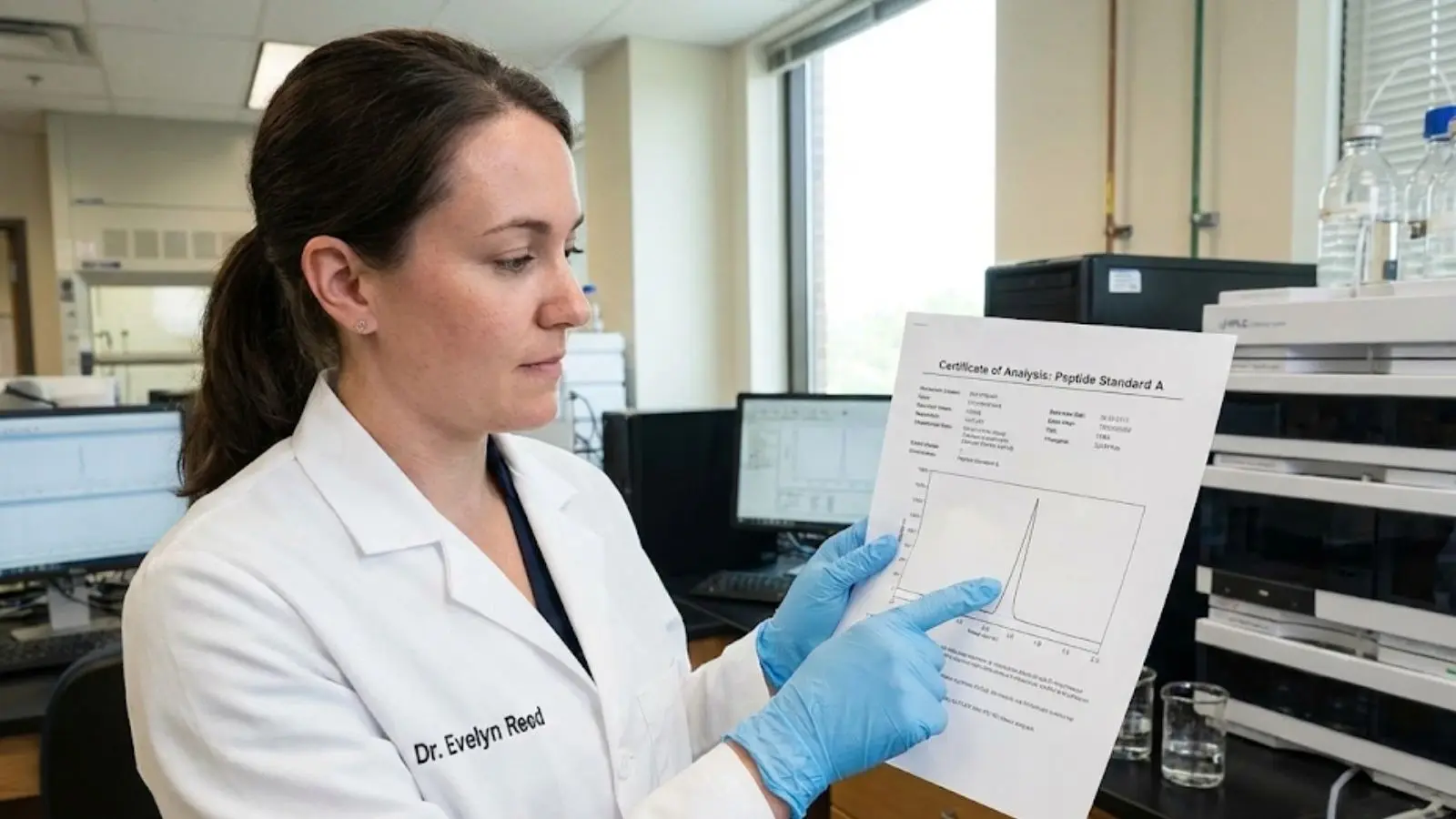
On this page
The peptide industry in 2026 is often described as the "Wild West." New vendors pop up overnight, promising 99% purity and miracle results. But for the serious researcher, a fancy label is not enough.
When you are sourcing scientific peptides for laboratory use, there is only one document that matters: the Certificate of Analysis (CoA).
This document is the difference between conducting a valid experiment and injecting unknown contaminants into your test subject. However, most buyers have no idea how to read one. They see a graph with a blue line, see the word "PASS," and assume everything is fine.
This guide will teach you how to analyze these reports like a chemist. We will break down the three critical sections of a CoA, Purity, Identity, and Net Content, so you can verify that you are getting true scientific peptides and not just expensive filler.
The Basics: What is a CoA?
A Certificate of Analysis is a lab report issued by a third-party testing facility. It confirms that the product inside the vial matches the label on the outside.
The Golden Rule: Never trust a vendor who tests their own products. "In-house testing" is a conflict of interest. True scientific peptides must be verified by an independent laboratory to ensure the data is unbiased. The gold standard for this verification is often Janoshik Analytical, a facility widely recognized in the research community for forensic analysis of grey-market compounds.
For a broader understanding of what these compounds actually are before you test them, start with our guide on What Are Peptides? The Ultimate Beginner’s Guide.
Part 1: HPLC (The Purity Test)
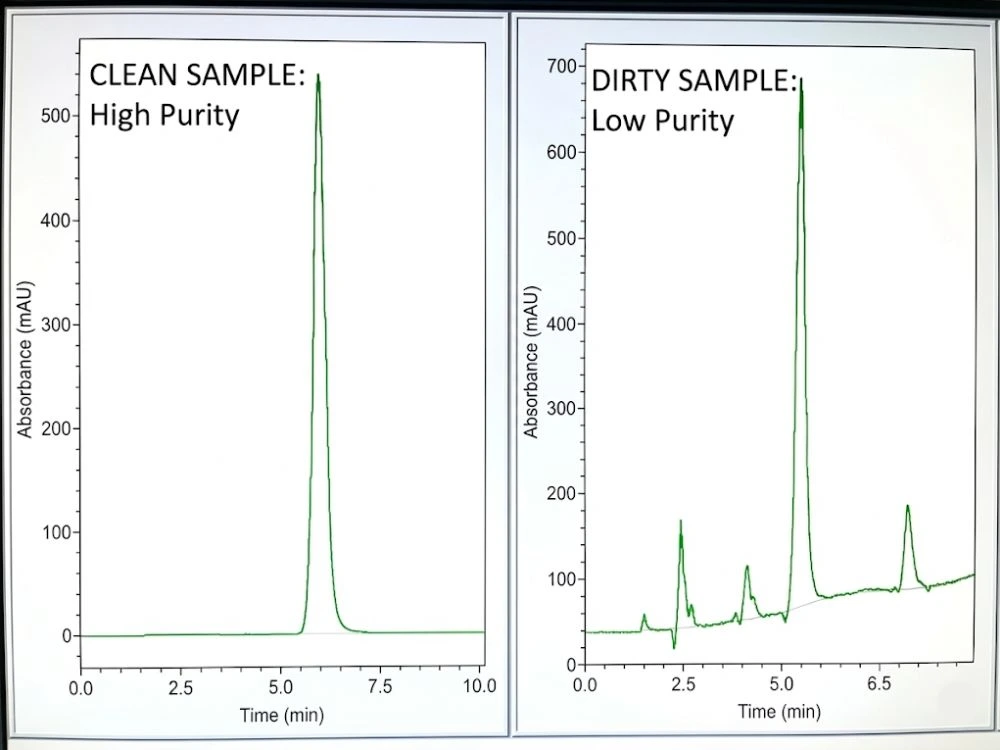
The first thing you will look for is a graph with a sharp spike. This is the High-Performance Liquid Chromatography (HPLC) report.
According to the National Center for Biotechnology Information (NCBI), HPLC separates components in a liquid mixture to identify and quantify each part. Think of the graph like a heartbeat:
- The Main Peak: This massive spike represents the peptide itself.
- The Flat Line: This represents the absence of other chemicals.
- The Tiny Bumps: These are impurities (synthesis byproducts or degradation).
How to Read It: You want to see one single, dominant tower. If you see a "forest" of smaller peaks surrounding the main one, the peptide is dirty. Look for the "Area %" number next to the main peak.
- >99%: Gold Standard. Clinical grade.
- 98%: Acceptable for most general research.
- <95%: Rejected. Do not use this for sensitive biological research.
Part 2: Mass Spectrometry (The Identity Test)
While HPLC tells you how clean the sample is, Mass Spectrometry (MS) tells you what the sample is.
It measures the molecular weight of the compound. Every peptide has a unique "fingerprint" weight measured in Daltons.
Example: Semaglutide has a molecular weight of approximately 4113 Daltons, which you can verify on the PubChem Database.
How to Read It: Look at the "Theoretical MW" (what it should be) versus the "Measured MW" (what it is). They should match almost perfectly. If the molecular weight is off, you don't have semaglutide; you have something else entirely.
For a deeper understanding of why molecular weight matters in defining these chains, read our article on Peptides and Polypeptides: Understanding the Molecular Differences.
Part 3: Net Peptide Content (The Hidden Variable)
This is the metric that confuses most researchers.
If you buy a vial labeled "5mg," does it contain 5mg of pure peptide? No. It contains 5mg of powder.
That powder consists of:
- The Peptide: (Usually 70–80% of the weight).
- Water & Counter-ions: (Residual moisture and salts like acetate or trifluoroacetate).
This is known as Net Peptide Content. It is not a flaw; it is a chemical reality of lyophilization (freeze-drying). However, if you are conducting precise dosing, you must account for this discrepancy.
To ensure your dosing math is accurate despite these variables, always use our Peptide Reconstitution Calculator before beginning your research.
Red Flags: How to Spot a Fake CoA
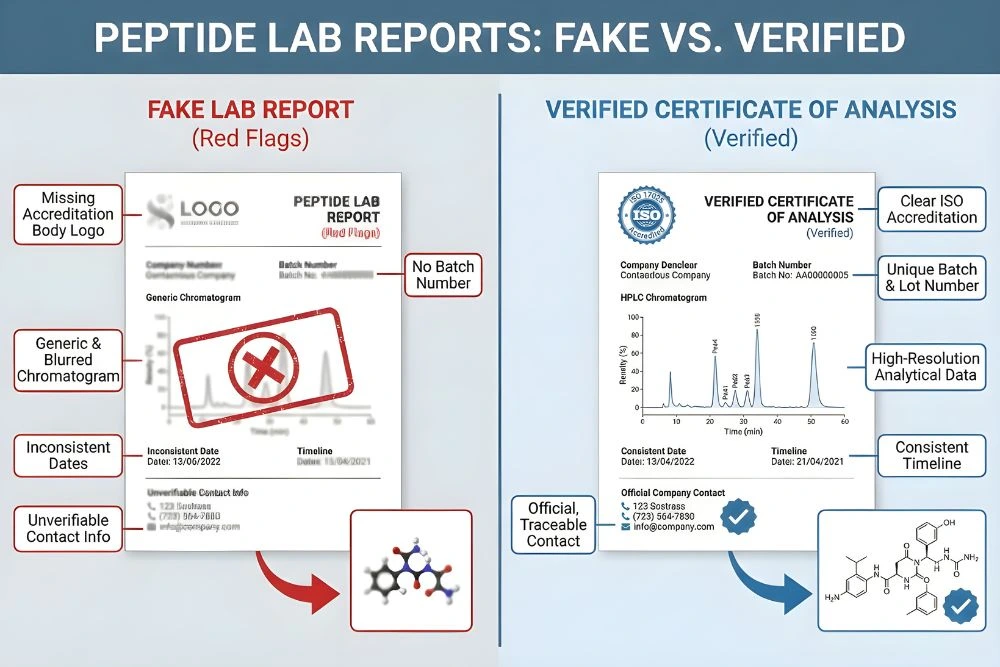
Unscrupulous vendors often fake these documents. Here is how to spot a forgery:
- Generic Dates: If the test date is from 2023, that report does not apply to the batch you are buying today.
- Missing Batch Numbers: The batch number on the CoA must match the batch number printed on your vial.
- Cropped Images: If the header (with the testing lab's name and contact info) is cropped out, run away. A legitimate vendor wants you to know who did the testing.
Why "Scientific Peptides" Demand Verification
Using unverified compounds ruins data. If your subject has an adverse reaction, was it the peptide, or was it a heavy metal contaminant? Without a CoA, you introduced a variable that makes your "scientific" experiment scientifically worthless.
In 2026, the standard for scientific peptides is transparency. If a vendor cannot prove what is in the bottle, they do not deserve your business.
Frequently Asked Questions
Conclusion
Reading a Certificate of Analysis is not just a formality; it is a skill that separates the amateur from the professional. By understanding the data behind scientific peptides, you ensure the integrity of your research and the safety of your subjects. Never settle for "trust me"—always demand the data.
Official Medical Disclaimer
The information provided in this guide is for informational and educational purposes only. Peptides and GLP-1 research compounds are intended strictly for laboratory research and are not for human consumption or for the diagnosis, treatment, or prevention of any disease. All research should be conducted by qualified professionals in a controlled environment. The statements regarding these products have not been evaluated by the Food and Drug Administration (FDA). Always consult your local laws and institutional guidelines regarding the use of peptides in research. Always seek the advice of your physician or other qualified health provider with any questions you may have regarding a medical condition.