
The Ultimate Guide to Collagen Peptides: Science, Synthesis, and Structural Health
Explore the research behind collagen peptides. Learn how hydrolyzed sequences support skin elasticity, joint integrity, & cell repair through clinical studies.
- Published
- Updated
- Reading time
- 9 min read
- Author
- By PeptidesFinder
On this page
In the world of health and research, collagen peptides have become a massive topic of discussion. You see them everywhere, from grocery store shelves to medical research labs.
But what are they, really?
Most people know that collagen has something to do with skin and joints. However, the science goes much deeper than just "anti-aging." Collagen is the primary structural building block of the human body. It makes up about 30% of all collagen protein in your system. It provides the strength and elasticity for your skin, bones, tendons, and ligaments.
As we move into 2026, research has shifted. We aren't just looking at basic supplements anymore. Scientists are now studying the precise "molecular synthesis" of these chains. They want to know how specific sequences of amino acids can signal the body to repair itself.
This guide is your complete resource. We will explore the biochemistry of hydrolyzed collagen, the different types you need to know, and the critical vitamins required to make it work.
What Are Collagen Peptides? (The Biochemistry)
To understand the supplement, you first need to understand the molecule.
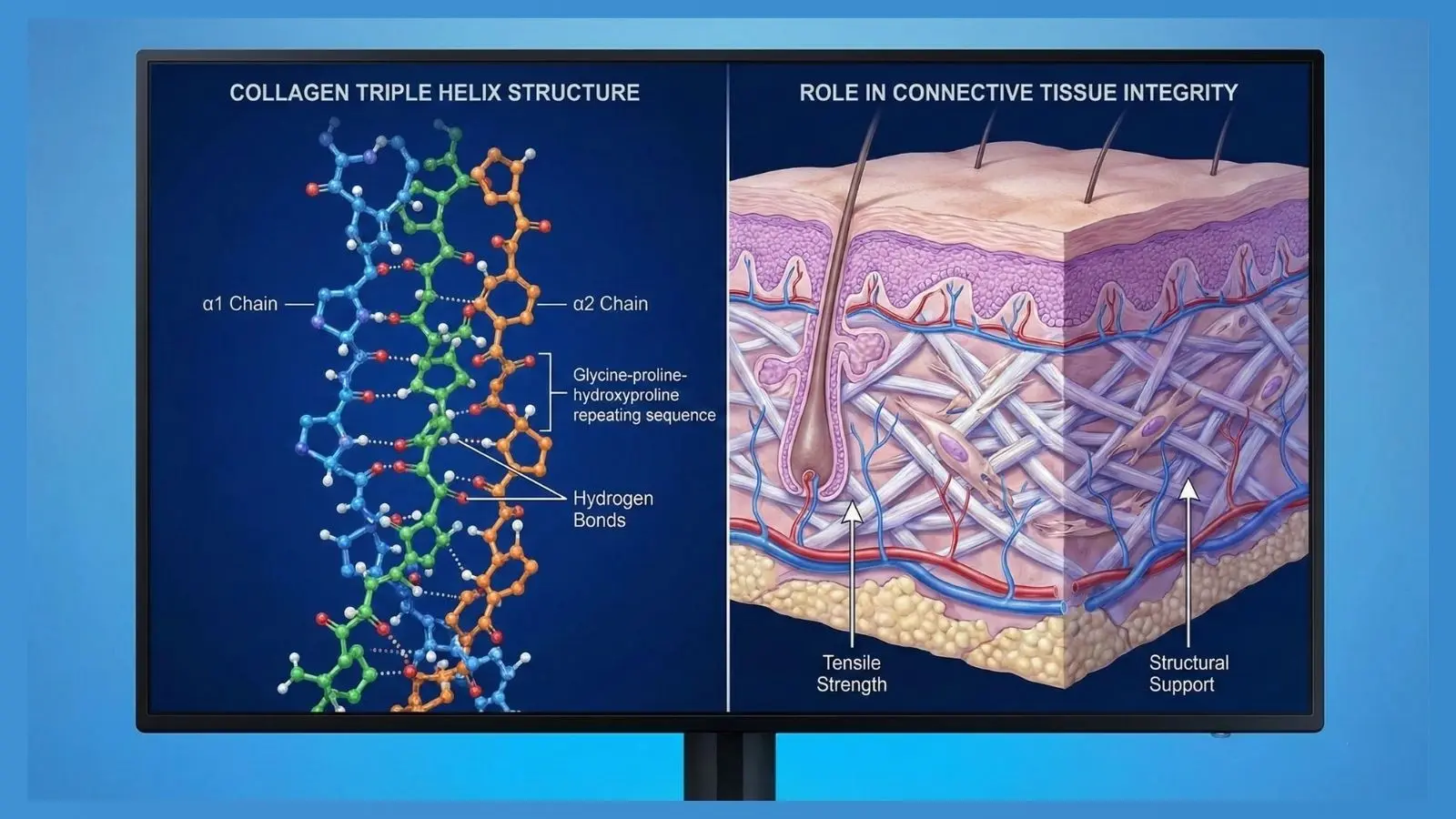
In its natural state, collagen is a massive protein. It is shaped like a triple helix—imagine three ropes twisted tightly together. This structure is incredibly strong, but it is also very large. In fact, "native" collagen is too big for your body to absorb effectively during digestion.
This is where science steps in.
Hydrolysis: Breaking It Down
The term "peptides" refers to the result of a process called hydrolysis.
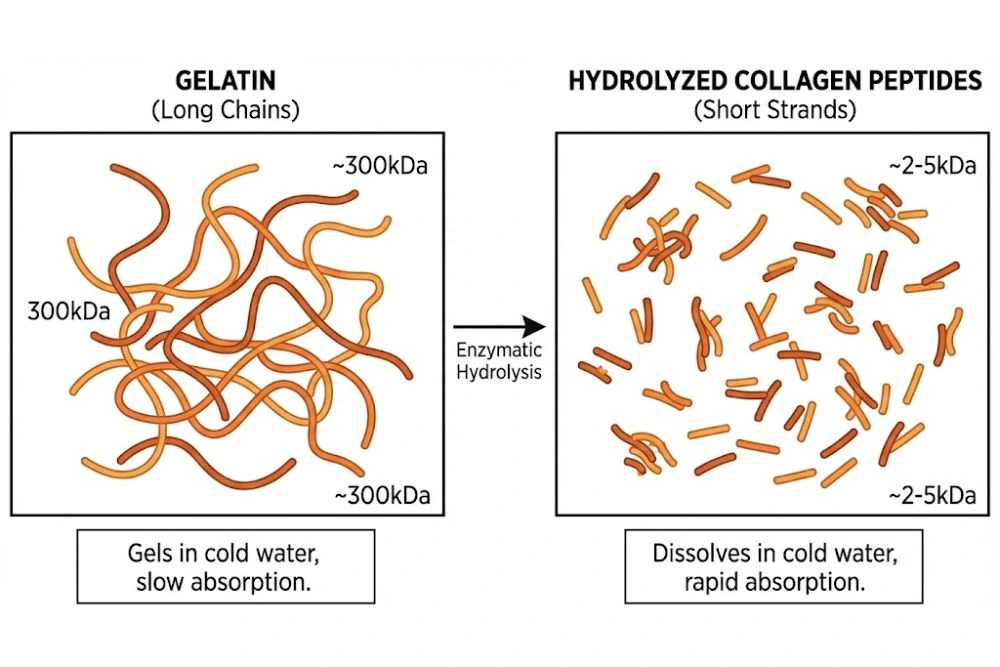
Native Collagen: This is the raw, unprocessed protein. It has a molecular weight of about 300,000 Daltons. That is huge.
Hydrolyzed Collagen: Scientists use water and enzymes to slice those long chains into tiny fragments. These pieces are called peptides. They have a molecular weight of just 2,000 to 5,000 Daltons.
Why Size Matters
Because they are so small, these peptides are highly bioavailable. This means your body can absorb them easily into the bloodstream.
Once absorbed, they act as "signaling molecules." They trick your body into thinking that its own collagen is breaking down. This triggers a repair response. Your body sends out an alert to specific cells:
- Fibroblasts: These cells live in your skin and produce new collagen networks.
- Osteoblasts: These cells live in your bones and help maintain density.
By consuming these peptides, you are essentially giving your body the raw materials and the signal to start rebuilding.
Internal Reference: To learn more about how small chains work, read our guide on Simple Peptides: The Scientific Advantage of Short-Chain Research Compounds.
The Amino Acid Profile: Glycine, Proline, and Hydroxyproline
Collagen is unique because of its "recipe." It is not like whey protein or meat. It has a very specific amino acid profile that you cannot find in other foods.
There are three main amino acids that make up the collagen helix:
- Glycine (The Anchor): Glycine is the smallest amino acid. It makes up roughly one-third of the collagen chain. Because it is so small, it allows the three strands of the helix to pack together very tightly. This gives collagen its incredible strength.
- Proline (The Twist): Proline is unique because of its shape. It causes the protein chain to twist and turn. This twisting action is what creates the "helix" shape. Without Proline, collagen would be flat and weak.
- Hydroxyproline (The Glue): This is perhaps the most important one for stability. Hydroxyproline is a modified version of Proline. It allows hydrogen bonds to form between the three strands, locking them together like glue.
This trio—Glycine, Proline, and Hydroxyproline—is the "magic formula" for structural health.
The Three Major Types of Collagen
Did you know there are actually 28 different types of collagen in the body? However, for most research and health purposes, we focus on the "Big Three." Different tissues in your body require different types of structural support.
Type I: The Skin and Bone Builder
Where is it? Type I makes up 90% of the collagen in your body. You find it in skin, tendons, blood vessels, organs, and bones.
What does it do? It provides tensile strength. Think of it like a steel cable. It prevents your tissues from tearing when they are stretched.
Best Sources: Marine (fish) collagen and Bovine (cow) collagen are rich in Type I.
Type II: The Joint Cushion
Where is it? This type is found almost exclusively in cartilage.
What does it do? Cartilage is the shock absorber between your joints. Type II collagen provides compressive strength, allowing your knees and hips to handle impact.
Best Sources: Chicken sternum cartilage is the standard source for Type II.
Type III: The Support System
Where is it? Type III is often found alongside Type I. It is in reticular fibers, which make up the mesh-like support structure for soft organs (like the liver and spleen) and skin.
What does it do? It provides elasticity and support for soft tissues. It is very prominent in young skin and blood vessels.
Mechanism of Action: How Synthesis Occurs
Taking a dietary supplement is only step one. Your body still has to do the work of building the protein.
This process is called collagen synthesis, and it happens inside your cells. It is a complex assembly line that requires specific tools to work.
The "Acid Vitamin" Connection
You may have heard of the "acid vitamin." This usually refers to Ascorbic Acid, better known as Vitamin C.
You physically cannot build collagen without Vitamin C. Here is why:
Inside the cell, enzymes called hydroxylases act as the construction workers. Their job is to add oxygen and hydrogen to the Proline and Lysine amino acids. This process, called "hydroxylation," is what turns Proline into Hydroxyproline.
Vitamin C is the fuel for these enzymes.
If you are deficient in Vitamin C, these enzymes stop working. The collagen your body produces becomes weak and unstable. This is the root cause of scurvy, a disease where old wounds open up and teeth fall out because the connective tissue dissolves.
Video: Collagen Synthesis Explained
This is a complex biological process. For a clear visual breakdown, watch this educational video on the biochemical pathway.
This video visualizes how ribosomes read mRNA to create the chains that eventually twist into the triple helix.
Hydrolyzed Collagen vs. Gelatin: What's the Difference?
This is a common point of confusion. Many researchers and consumers mix up collagen peptides with gelatin. They come from the same source, but they behave very differently.
-
Gelatin
What is it? Gelatin is partially cooked collagen.
Structure: The chains are longer and heavier.
Behavior: It turns into a gel when mixed with cold water (think of Jell-O).
Digestion: It is harder for the body to break down and absorb compared to peptides.
Use Case: Mostly used in cooking or making gummies. -
Hydrolyzed Collagen (Peptides)
What is it? Collagen that has been aggressively processed with enzymes.
Structure: The chains are chopped into tiny, light fragments.
Behavior: It dissolves perfectly in cold water without gelling.
Digestion: It has high bioavailability and enters the bloodstream rapidly.
Use Case: Used for tissue repair, skin health, and joint support supplements.
Dietary Sources vs. Supplements
Can you get enough collagen from food alone?
Technically, yes. However, the modern western diet often lacks the specific parts of the animal that are rich in connective tissues. We tend to eat lean muscle meat (like chicken breast or steak), which is low in Glycine and Proline.
To get collagen naturally, you need to eat the "tough" bits:
- Bone Broth: Simmering bones for 24+ hours releases Type I and II collagen into the liquid.
- Fish Skin: This is one of the most potent natural sources of Type I collagen.
- Chicken Skin & Cartilage: The cartilage on chicken wings or drumsticks is pure Type II collagen.
- Organ Meats: Liver and heart contain higher amounts of connective tissue than muscle meat.
If you cannot consistently eat bone broth or organ meats, collagen supplements act as a convenient insurance policy. They guarantee you get the specific amino acids needed for repair without altering your entire diet.
Benefits of Collagen Supplementation
Research into collagen peptide supplementation has exploded in the last decade. Here is what the current data says about its effects on the body.
-
Skin Health and Hydration:
A comprehensive review and meta-analysis of 19 studies involving 1,125 participants found that those who used collagen supplements saw significant improvements in elasticity. The studies highlighted skin hydrating effects, with users retaining more moisture in the dermal layers. -
Joint Pain and Mobility:
Numerous clinical trials have demonstrated that supplementing with Type II collagen can reduce joint stiffness. The effect of collagen on cartilage repair is substantial, helping maintain the "cushion" between bones for smooth movement. -
Bone Density:
Bones are not just calcium; they are a matrix of collagen hardened by minerals. Collagen peptides can help stimulate osteoblasts (bone builders), which is crucial for preventing bone loss as we age. -
Muscle Mass and Strength:
While collagen is not a complete protein like whey, it is vital for the extracellular matrix of muscle. A strong matrix allows your muscles to transfer force more efficiently, potentially improving strength and power output.
Frequently Asked Questions
Is collagen a complete protein?
No. Collagen is missing Tryptophan, one of the nine essential amino acids. It is a "functional" protein meant for structural repair, not a complete food source like eggs or meat.
How long does it take to see results?
Skin: Most studies show measurable changes after 4 to 8 weeks of daily use.
Joints: Improvements in comfort often require 3 to 6 months of consistent use.
Can I take it with coffee?
Yes! Hydrolyzed collagen is heat-stable. You can mix it into hot coffee or tea without destroying the protein.
What is the best time to take it?
Consistency beats timing. Many athletes prefer post-workout use for tissue repair, while others take it before bed to support recovery during sleep.
Are there vegan collagen peptides?
Technically, no. True collagen is an animal product.
"Vegan Collagen" products are usually blends of vitamins like Vitamin C, Zinc, and Silica that support natural collagen production. Some labs are experimenting with fermented collagen using genetically modified bacteria, but this is still new and expensive.
Does it help with "Leaky Gut"?
There is growing evidence that collagen supports gut health. The amino acids Glutamine and Glycine help "seal" the gut lining, reducing inflammation and improving digestion.
Conclusion
Collagen peptides are far more than just a beauty trend. They are a fundamental component of human structural biology.
Whether you call it hydrolyzed collagen, gelatin, or connective tissue, the science is clear: your body relies on these amino acid sequences to hold everything together. From the bounce in your skin to the shock absorption in your knees, collagen is the glue.
By understanding the differences between the types (I, II, and III) and ensuring enough Vitamin C to support synthesis, you can take a targeted approach to your health.
Internal Reference: For more on skin-specific peptides, compare this with GHK-Cu Copper Peptides: The Science of Skin Regeneration.
Internal Reference: Confused about the basics? Start with What Are Peptides? The Ultimate Beginner’s Guide.
Official Medical Disclaimer
The information provided in this guide is for informational and educational purposes only. Peptides and GLP-1 research compounds are intended strictly for laboratory research and are not for human consumption or medical use. All research should be conducted by qualified professionals in a controlled environment. The statements regarding these products have not been evaluated by the Food and Drug Administration (FDA). Always consult your local laws and institutional guidelines regarding the use of peptides in research, and seek the advice of your physician or other qualified health provider regarding any medical condition.