
Where to Buy BPC-157: Third-Party Tested Sources
Looking for where to buy BPC-157? Discover the top third-party tested sources for research-grade BPC-157 in 2026, plus the science behind why it matters.
- Published
- Updated
- Reading time
- 16 min read
- Author
- By PeptidesFinder
On this page
Where to Buy BPC-157 in 2026: Verified Research-Purity Sources and Science Overview
BPC-157 has become one of the most searched research peptides online for good reason. The published preclinical data on its tissue repair, anti-inflammatory, and angiogenic properties is extensive and consistent across multiple independent research groups. Dozens of studies involving muscle, tendon, ligament, bone, gut, and vascular tissue have examined its effects. The results have been compelling enough to drive a significant wave of researcher interest over the past decade.
The challenge is not finding BPC-157 for sale online. The challenge is finding a source where the product in the vial actually matches what the label says. The research peptide market has a real purity problem, and BPC-157 is one of the most commonly counterfeited or adulterated compounds in the space. For anyone serious about using BPC-157 in a legitimate research context, vendor selection is not a secondary consideration, it is a primary one.
This guide covers the science behind why BPC-157 has attracted so much research interest, what separates a reliable source from a risky one, and the two vendors we recommend for third-party verified BPC-157 in 2026.
Where to Buy BPC-157 in 2026: Our Two Recommended Sources
After evaluating the vendor landscape against the criteria above, two sources stand out as the clearest recommendations for researchers sourcing BPC-157 in 2026. Both provide third-party tested documentation, have maintained operational continuity through the market disruptions of 2025, and have independently verifiable community reputations.
Top Pick: NextGen Peptides
NextGen Peptides is our top recommendation for BPC-157 in 2026. Their community standing is among the strongest of any currently active peptide vendor, with over 400 Trustpilot reviews consistently praising product quality, shipping speed, and customer service. Multiple independent reviewers have specifically noted that their BPC-157 and other peptides matched provided documentation when independently tested, which is the most reliable external validation a vendor can receive.
NextGen ships domestically with most orders arriving within 2 to 3 days. Their BPC-157 comes with COA documentation, and the overall ordering and fulfillment experience has been described by returning customers as among the most professional in the market. Their catalog covers the full range of core and specialty research peptides, making them a practical primary source for researchers working with multiple compounds.
Researchers who want a vendor with proven documentation standards, fast reliable shipping, and a customer service team that gets flagged positively in independent reviews will find NextGen a straightforward choice. Their BPC-157 is available here NextGen Peptides.
Runner-Up: Ascension Peptides
Ascension Peptides earns the runner-up position on the strength of their documentation transparency. Every product page on their site links directly to third-party COAs, making pre-purchase verification possible without contacting support. For researchers who treat COA review as a required step before any order, this accessibility removes friction from the process.
Ascension holds a 4.8 out of 5 star Trustpilot rating with reviewers specifically citing their clean documentation practices, fast US domestic shipping, and responsive customer support. They have maintained continuous operations through the regulatory disruptions of 2024 and 2025, which is a meaningful operational stability signal. Their catalog is comprehensive, covering GLP-1 class compounds, secretagogues, healing peptides, nootropics, and specialty blends alongside their core offerings including BPC-157.
For documentation-first researchers who want third-party COAs accessible before committing to a purchase, Ascension Peptides is the natural fit. Their BPC-157 is available here Ascension Peptides.
What Is BPC-157 and What Does the Research Actually Show?
BPC-157 stands for Body Protection Compound 157. It is a synthetic pentadecapeptide, meaning a chain of exactly 15 amino acids, with the sequence GEPPPGKPADDAGLV. The compound was first isolated from human gastric juice in 1993 by Dr. Predrag Sikiric and his team at the University of Zagreb. Its sequence is derived from a larger gastric protein involved in maintaining mucosal integrity, which explains one of BPC-157's most unusual properties: it is exceptionally stable in acidic conditions, surviving intact in gastric juice for over 24 hours, where most peptides would be rapidly degraded.
This stability is one reason BPC-157 has attracted sustained research interest. Unlike most biologically active peptides that require complex delivery systems or protective carriers to function after administration, BPC-157 works with relatively straightforward routes and maintains its activity across tissues well beyond its site of introduction.
Tendon and Musculoskeletal Repair
The most replicated findings in BPC-157 research involve musculoskeletal healing. A 2025 systematic review published in PMC (PMC12313605) examined 36 studies on BPC-157 from an orthopaedic sports medicine perspective, spanning literature from 1993 to 2024. The review found that BPC-157 consistently improved outcomes in muscle, tendon, ligament, and bone injury models in animals. The proposed mechanisms include upregulation of growth factor signaling pathways, enhancement of cell proliferation and survival, promotion of angiogenesis, and reduction of inflammatory cytokines including IL-6 and TNF-alpha.
The foundational tendon study, published in the Journal of Orthopaedic Research and accessible via PubMed (PMID 14554208), tested BPC-157 in rats with completely transected Achilles tendons. Treated animals showed full recovery of tendon integrity assessed by biomechanical loading tests, Achilles functional index scores, and histological examination of fibroblast and collagen formation. The compound was effective when given systemically rather than locally, and was active at doses as low as 10 picograms per kilogram, suggesting high potency at very low concentrations.
A follow-up study examining the cellular mechanism behind this effect, available via PubMed (PMID 21030672), found that BPC-157 significantly accelerated the outgrowth of tendon fibroblasts from explant cultures, increased cell survival under oxidative stress, and markedly enhanced fibroblast migration in a dose-dependent manner through activation of the FAK-paxillin signaling pathway. These are the molecular steps that drive tendon repair at the cellular level, and BPC-157 appears to amplify all of them simultaneously.
Angiogenesis and the Nitric Oxide Pathway
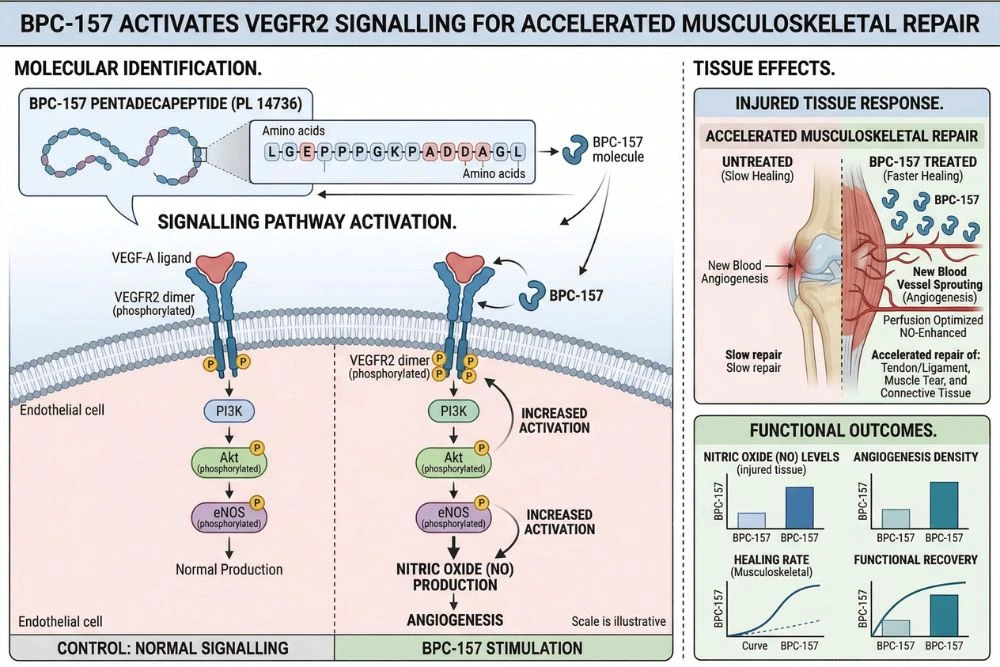
One of the most important and well-documented mechanisms of BPC-157 is its effect on angiogenesis, the formation of new blood vessels. This is particularly relevant for injuries to poorly vascularized tissues like tendons and ligaments, where inadequate blood supply is a primary reason these injuries heal slowly and incompletely.
BPC-157 activates the VEGFR2-Akt-eNOS pathway, upregulating vascular endothelial growth factor receptor 2 and triggering a downstream cascade that promotes nitric oxide production, endothelial cell migration, and vascular tube formation. A 2020 study published in Scientific Reports and confirmed via PMC (PMC7555539), showed that BPC-157 also acts through a second, VEGF-independent pathway by disrupting the Src-Caveolin-1-eNOS inhibitory complex, directly promoting nitric oxide synthesis in vascular endothelial cells. This dual-pathway angiogenic activity explains why BPC-157's healing effects extend across tissue types with very different vascular architectures.
A 2025 narrative review published in PMC (PMC12446177), synthesized the full mechanistic picture: BPC-157 activates VEGFR2, ERK1/2, FAK, and multiple downstream transcription factors including c-Fos, c-Jun, and EGR-1. These overlapping pathways collectively promote angiogenesis, fibroblast activity, neuromuscular stabilization, and anti-inflammatory effects. The review also notes that three human pilot studies have been conducted, examining intraarticular knee injection for chronic pain, interstitial cystitis, and intravenous pharmacokinetic safety, with one pilot finding that 7 out of 12 patients with chronic knee pain experienced relief for more than six months following a single BPC-157 injection.
Gut and Systemic Cytoprotection
Because BPC-157 originates from gastric biology, its gastrointestinal effects have been extensively studied. Animal research has shown it promotes healing of gastric ulcers, protects intestinal tissue from inflammatory damage, accelerates colonic anastomosis healing, and maintains mucosal integrity under a range of chemically induced injury conditions. This gut-protective profile is consistent with the compound's natural origin as a component of gastric homeostasis biology.
Beyond the gut, BPC-157 has been studied in cardiac tissue, where it has been shown to counteract doxorubicin-induced cardiomyopathy and reduce big endothelin-1 plasma concentrations elevated by congestive heart failure. Neurological research has also examined its role in counteracting dopaminergic and serotonergic disturbances, protecting against NSAID-induced organ damage, and accelerating recovery from traumatic brain injury and spinal cord damage in animal models. This unusually broad systemic activity profile is one of the reasons BPC-157 has attracted such diverse research interest across specialties.
A comprehensive review of BPC-157's multifunctionality, including its gastrointestinal, musculoskeletal, cardiovascular, and neurological research profile, was published in MDPI Pharmaceuticals in 2025 and is accessible at MDPI Pharmaceuticals 2025. The review covers the compound's pleiotropic activity across organ systems and summarizes the current evidence for its applications and safety profile, noting that no toxic or lethal dose has been established across the wide range studied in animal models and that no teratogenic, genotoxic, or anaphylactic effects were observed.
BPC-157 Safety Profile: What the Preclinical Data Shows
One aspect of BPC-157's research profile that deserves specific attention is its safety data, because it is more favorable than for most research peptides with comparable activity profiles.
The 2025 systematic review in orthopaedic sports medicine specifically examined safety outcomes across the published literature. In preclinical animal studies, BPC-157 was not associated with acute gross or histologic toxicity across multiple organs including the liver, spleen, lung, kidney, brain, thymus, prostate, and ovaries. No toxic or lethal dose was achieved across a range spanning from 6 micrograms per kilogram to 20 milligrams per kilogram, an extremely wide therapeutic window by any standard. The compound has shown no teratogenic effects in reproductive studies and no genotoxic activity.
One safety consideration worth noting is BPC-157's pro-angiogenic activity. Because the formation of new blood vessels is also a mechanism by which tumors sustain their own growth, a theoretical concern has been raised about whether BPC-157's angiogenic effects could support tumor development in cancer-predisposed or cancer-bearing organisms. Existing in vitro evidence has shown inhibitory effects of BPC-157 on a melanoma cell line, suggesting the angiogenic activity is modulated rather than simply amplified, but this question has not been comprehensively investigated. Researchers working in oncology contexts or with animal models involving cancer should factor this into protocol design.
The overall preclinical safety picture is one of the more favorable in the research peptide space, which partly explains why human pilot studies have progressed to examining intravenous administration for pharmacokinetic profiling. However, translating preclinical safety to clinical safety always requires formal human trials, and the evidence base for BPC-157 in humans remains very limited.
The Sourcing Problem: Why Where You Buy BPC-157 Matters More Than Most Peptides
BPC-157 is one of the most popular research peptides on the market, which means it is also one of the most frequently counterfeited and adulterated. The demand is high, the compound is profitable, and the regulatory environment for research chemicals means there is limited enforcement at the vendor level for compounds that do not match their labels.
The practical consequences for researchers are significant. An underdosed product produces no meaningful research outcomes and wastes resources. A misidentified product introduces unknown variables that invalidate results entirely. A contaminated product introduces endotoxins or residual synthesis chemicals that are biologically active in ways that have nothing to do with BPC-157's pharmacology, producing false signals in any biological assay.
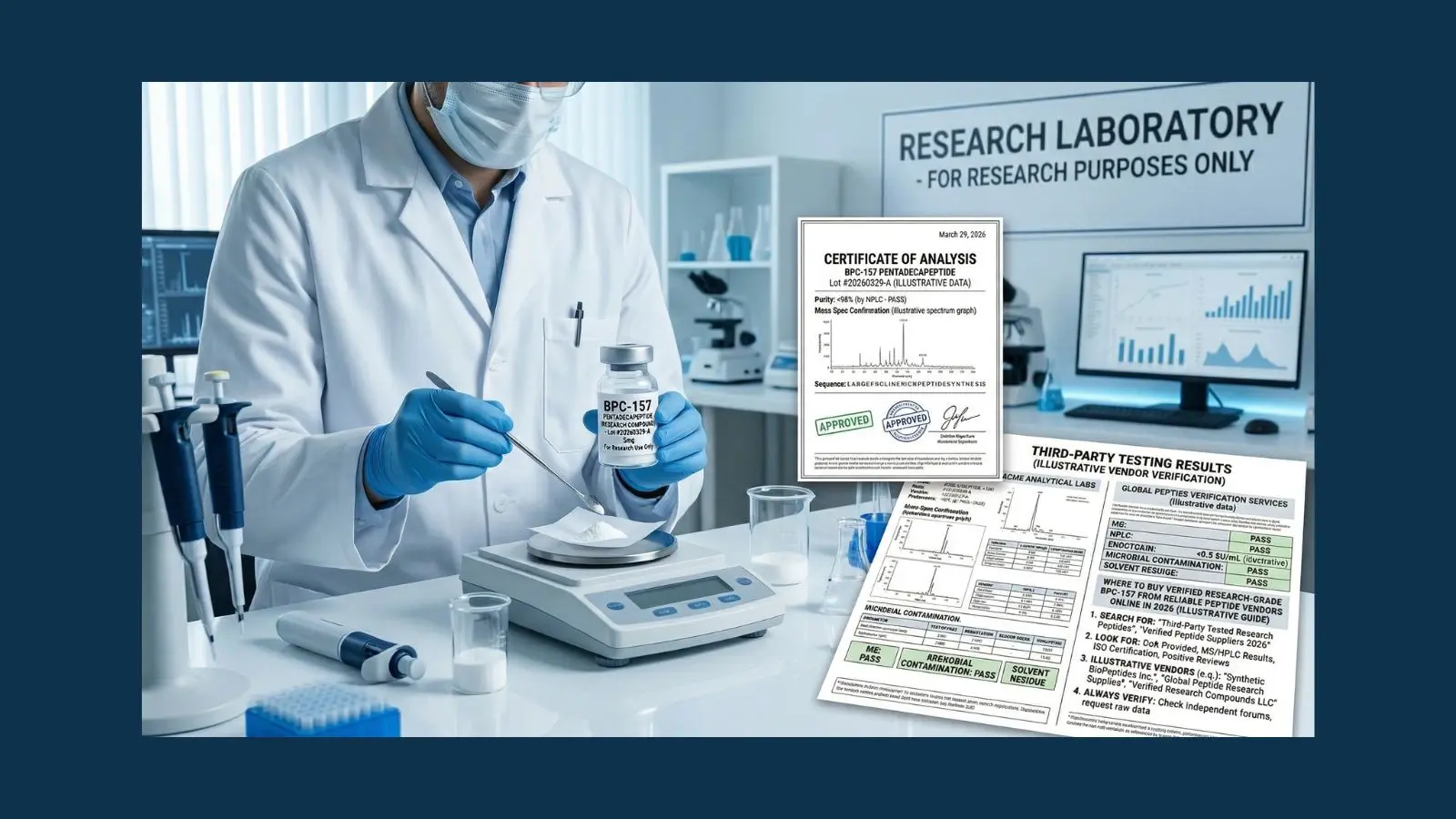
The single most important protection against all three of these problems is third-party tested documentation. A vendor cannot fake a Certificate of Analysis issued by an independent accredited laboratory. If the purity data and mass spectrometry identity confirmation come from an external lab with no financial relationship to the vendor, the document provides genuine quality assurance. If it comes from the vendor's own in-house testing, it provides none.
What to insist on: A Certificate of Analysis (COA) from a named, independent third-party laboratory confirming identity by mass spectrometry and purity by HPLC chromatography, with a lot or batch number that matches the product you receive.
What to ignore: Vague quality claims, in-house certificates with no lab name, purity percentages without analytical data backing them, or vendors who make the COA difficult to obtain.
The 2025 enforcement context: The FDA's June 2025 enforcement actions against several major peptide vendors reshaped the US market significantly. Vendors that have maintained continuous, uninterrupted operations through and after this period carry substantially lower sourcing risk than those who went dark and relaunched, or who are new to the market.
For a complete walkthrough of how to read and evaluate a Certificate of Analysis, including what each section means and how to spot documentation that looks legitimate but is not, the Certificate of Analysis guide on PeptidesFinder covers every element in detail.
Research Context: What Scientists Working with BPC-157 Need to Know
BPC-157 is not FDA-approved for human therapeutic use and is classified as a research chemical. All published efficacy data comes from preclinical animal models and a small number of human pilot studies. Researchers working with this compound should do so within properly authorized institutional protocols with appropriate ethical oversight.
Forms and Administration in Research
BPC-157 is available in two primary forms for research: lyophilized powder for reconstitution into injectable solution, and oral capsule formulations. The injectable form is most commonly used in preclinical models targeting musculoskeletal, vascular, or systemic effects. The oral form is relevant for gastrointestinal research, where BPC-157's unusual gastric stability makes oral bioavailability feasible in a way that is not possible for most peptides.
Reconstitution of lyophilized BPC-157 typically uses sterile bacteriostatic water. The compound dissolves readily without special handling, consistent with the stability properties noted in the original isolation research. Storage of lyophilized material at -20 degrees Celsius is standard, with reconstituted solutions used within 30 days under refrigeration.
Dosing in Preclinical Research
Animal studies in the published literature have used a wide range of doses, from 10 picograms per kilogram to 10 micrograms per kilogram per day. The 2025 systematic review noted that the compound showed no toxic or lethal dose across the full range studied (6 micrograms per kilogram to 20 milligrams per kilogram), and no gross or histologic organ toxicity was observed in acute study periods. Extrapolating animal dosing to human-equivalent calculations requires appropriate pharmacokinetic adjustment. A peptide calculator is an essential tool for converting mg/kg protocols to solution volumes based on your working concentration.
BPC-157 and TB-500: A Common Research Pairing
BPC-157 is frequently studied alongside TB-500 (thymosin beta-4) in tissue repair research, because their mechanisms are complementary. BPC-157 drives repair primarily through nitric oxide signaling, VEGF upregulation, and FAK-paxillin cell migration pathways. TB-500 drives repair through actin dynamics, G-actin sequestration, and a second independent angiogenic pathway. Together they address different steps in the repair cascade with minimal pathway overlap, which is why researchers investigating complex injury recovery models often study them in combination. For a full breakdown of TB-500's biology and research profile, the TB-500 research guide covers its mechanism and evidence base in detail.
Frequently Asked Questions
Is BPC-157 legal to buy online?
BPC-157 is legal to purchase online in the United States as a research chemical for laboratory research purposes. It is not FDA-approved for human therapeutic use, and vendors are not permitted to make health claims or market it for human consumption. The FDA's 2025 enforcement actions targeted vendors who were operating outside the research chemical framework or making therapeutic claims. Purchasing BPC-157 from a vendor who operates clearly within the research chemical space, provides third-party tested documentation, and does not make human health claims carries the lowest regulatory risk for researchers.
What is the difference between BPC-157 and BPC-157 Arginate?
BPC-157 Arginate, also labeled as BPC-157 acetate, is a salt form of the standard BPC-157 compound. The standard form has the sequence GEPPPGKPADDAGLV, while the arginate variant has an arginine salt added to improve solubility and stability in certain formulations. Most of the published research was conducted with the standard BPC-157 sequence. The arginate form has been studied and appears to produce similar biological activity, but researchers should note which form is being used in their protocol and ensure their sourced compound matches the form used in the reference literature for their specific research question.
How do I know if a BPC-157 vendor is legitimate?
The core test is documentation. Request the Certificate of Analysis for the specific lot number of your order before or immediately after purchase. The COA should identify a named third-party laboratory, include HPLC purity data showing the chromatographic trace, and include mass spectrometry confirmation of the molecular identity. The lot number on the COA should match the lot number printed on your vial. Beyond documentation, check Trustpilot independently (not testimonials on the vendor's own site), look for evidence of continuous operation through 2025, and assess whether the vendor makes the documentation process easy or difficult. Legitimate operations make COAs easy to access because their products pass testing. Operations that resist providing documentation have a reason.
Why does BPC-157 sourcing matter more than for some other peptides?
BPC-157 is one of the highest-demand peptides in the research market, and high demand always attracts more counterfeit and adulterated product. It is also a compound that is easy to simulate in appearance: a white lyophilized powder of roughly the right weight looks identical to the real compound. Without analytical testing, there is no way to distinguish BPC-157 from a less expensive filler or an entirely different compound. The consequences for research are significant: underdosed material produces no results, misidentified material produces false results, and contaminated material introduces uncontrolled variables. Third-party testing is the only protection against all three.
Can BPC-157 be taken orally?
BPC-157 is unusual among research peptides in that oral administration appears to be viable, owing to its remarkable stability in gastric juice. The standard concern with oral peptide administration, that stomach acid and digestive enzymes will degrade the compound before it reaches systemic circulation, applies much less forcefully to BPC-157 than to most peptides. Animal research has demonstrated activity from oral administration, particularly for gastrointestinal applications where the gut itself is the target tissue. For research targeting systemic effects such as musculoskeletal repair, subcutaneous or intraperitoneal injection is used in the preclinical literature and provides more predictable distribution. The route selection should be matched to the research question and the reference protocols most relevant to the study.
What should I store BPC-157 in after reconstitution?
Reconstituted BPC-157 should be stored in a refrigerator at 2 to 8 degrees Celsius and used within 30 days of reconstitution. Exposure to light, repeated temperature cycling, and contamination from non-sterile technique are the primary sources of degradation in reconstituted peptide solutions. For longer storage, lyophilized (unreconstituted) BPC-157 maintains stability at -20 degrees Celsius for 24 months or more under ideal conditions. Preparing aliquots of the reconstituted solution rather than repeatedly accessing a single vial is standard practice to minimize freeze-thaw degradation and contamination risk.
What makes NextGen Peptides and Ascension Peptides stand out for BPC-157?
Both vendors provide third-party Certificate of Analysis documentation, which is the baseline requirement for any serious research sourcing decision. Beyond that baseline, NextGen Peptides distinguishes itself through a large verified Trustpilot review base, exceptionally fast domestic shipping, and customer service that has been independently recognized as responsive and proactive. Ascension Peptides distinguishes itself through documentation transparency, specifically making third-party COAs accessible directly on every product page rather than only on request, which allows researchers to verify quality before placing an order. Both have demonstrated operational continuity through the 2025 regulatory disruptions that reshaped the vendor landscape.
Conclusion: Start with the Science, End with Documentation
BPC-157's research profile is genuinely compelling. Across more than 30 years of preclinical literature involving multiple independent research groups, multiple tissue types, multiple injury models, and now a growing number of human pilot studies, the findings have been consistent: BPC-157 accelerates tissue repair, promotes angiogenesis, reduces inflammation, and does so across a broader range of biological contexts than most research peptides. The mechanistic understanding of how it works, through VEGFR2-Akt-eNOS signaling, FAK-paxillin migration activation, ERK1/2 pathway engagement, and dual-pathway nitric oxide modulation, is detailed enough to explain why.
None of that research value translates to your lab if the compound in the vial is not actually BPC-157 at the purity the label claims. The starting point for any BPC-157 research protocol is a verified, third-party tested source. The two vendors we recommend, NextGen Peptides and Ascension Peptides, meet that standard and have the independent community track records to back it up.
For researchers new to BPC-157 who want a deeper grounding in its full research profile before sourcing, the BPC-157 Comprehensive Research Guide covers the complete evidence base, mechanism of action, and research considerations in depth.
Watch for the upcoming Sermorelin Benefits: How It Restores HGH Levels Naturally, covering another foundational research peptide with a long clinical history and a clear mechanistic basis.
Official Research Disclaimer
The information provided in this guide is for informational and educational purposes only. BPC-157 is sold as a research chemical and is not FDA-approved for human use. Research peptides are intended strictly for laboratory research and are not for human consumption or for the diagnosis, treatment, or prevention of any disease. All research should be conducted by qualified professionals in controlled environments with proper ethical oversight. This article does not constitute medical advice. Always consult a licensed healthcare provider before using any research compound. Never disregard professional medical advice or delay seeking it because of information you read online. The author and publisher disclaim any liability for adverse effects resulting from the use or application of the information contained herein.
Affiliate Disclosure: PeptidesFinder has affiliate relationships with the vendors featured in this guide. We may earn a commission on purchases made through links on this page, at no additional cost to you.