
Cyclic Citrullinated Peptide (CCP): Understanding the Diagnostic Test
What is a Cyclic Citrullinated Peptide (CCP) test? We explain how this antibody test diagnoses rheumatoid arthritis, and what your levels indicate.
- Published
- Reading time
- 7 min read
- Author
- By PeptidesFinder

On this page
In the world of peptide research, we often focus on compounds used for therapy or performance enhancement. However, peptides also play a critical role in diagnostics. One of the most important tests in modern rheumatology revolves around a specific type of modified molecule known as the Cyclic Citrullinated Peptide (CCP).
If you have recently visited a doctor for persistent joint pain or morning stiffness, you may have seen "Anti-CCP" on your lab order. But what exactly is this peptide? Why does measuring it help doctors identify autoimmune diseases like Rheumatoid Arthritis (RA) with such high accuracy?
This guide breaks down the science behind the test. We will explain the biological process of citrullination, why your body might attack these peptides, and what your results mean for your long-term structural health.
The Biology: What Is Citrullination?
To understand the test, we first need to understand the underlying biochemistry.
A peptide is simply a short chain of amino acids. (For a refresher on the basics, read our guide on What Are Peptides? The Ultimate Beginner’s Guide to Peptide Therapy).
In a healthy body, proteins and peptides generally maintain a stable structure. However, under certain conditions, an amino acid called arginine can undergo a chemical change. Through an enzymatic process, arginine is converted into citrulline. This process is called citrullination.
This shape-change can happen naturally as cells die or during inflammation. In a healthy immune system, this conversion is ignored. The body recognizes it as a normal part of the waste-disposal process.
When the Immune System Attacks
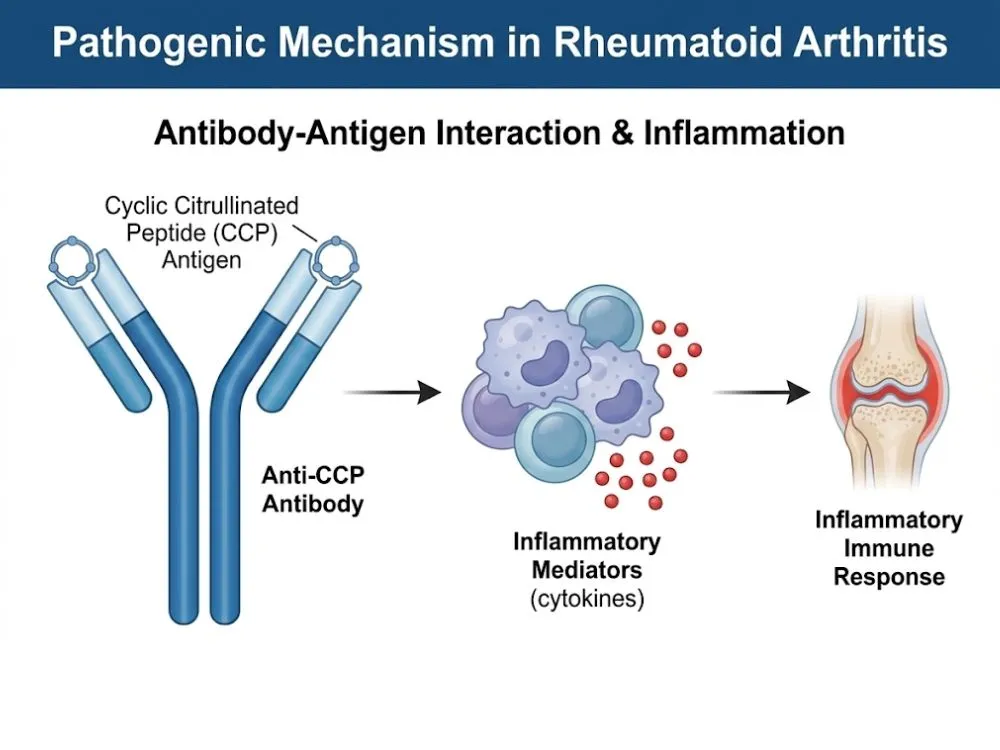
In individuals with a genetic predisposition to Rheumatoid Arthritis, the immune system makes a critical error. It identifies these citrullinated peptides as foreign invaders, similar to a virus or bacteria.
In response, the body produces specific antibodies to attack them. These are called Anti-Cyclic Citrullinated Peptide (Anti-CCP) antibodies.
So, when a doctor orders a "CCP Test," they are not measuring the peptide itself. They are measuring your body's immune reaction against that peptide. The presence of these antibodies is a red flag that the immune system is actively targeting your own joint tissues.
CCP vs. Rheumatoid Factor: The Superior Test
For decades, the standard screening tool for arthritis was the Rheumatoid Factor (RF) test. While useful, RF has a major flaw. It has low specificity.
Rheumatoid Factor can test positive in people who do not have arthritis. It can be triggered by chronic infections (like Hepatitis C), other autoimmune conditions (like Sjogren's syndrome), or even simple aging.
The CCP test revolutionized diagnosis because of its precision. According to a systematic review published in PubMed (Annals of Rheumatic Diseases), the Anti-CCP test demonstrates a specificity of approximately 95% to 98% for Rheumatoid Arthritis. This means that if you test positive, it is highly probable that you have the condition, minimizing the risk of a false diagnosis.
Furthermore, Anti-CCP antibodies are an early warning system. They can appear in the bloodstream up to 10 years before the first symptom of joint pain occurs. This allows for earlier intervention, which is key to preventing permanent damage.
Prognostic Value: Predicting Disease Severity
The CCP test does more than just say "Yes" or "No." The level of antibodies can also predict the future course of the disease.
Research indicates that patients with high titers (high levels) of Anti-CCP antibodies tend to have a more aggressive form of arthritis. They are at higher risk for:
- Bone Erosion: Faster destruction of the bone within the joint.
- Radiographic Progression: Visible damage on X-rays occurring sooner.
- Extra-articular Manifestations: Issues affecting organs outside the joints, such as the lungs.
Understanding this risk allows doctors to be more aggressive with treatment plans early on to preserve joint function.
Interpreting Your Lab Results
When you get your lab report back, you will typically see a number measured in units (U/mL). While every lab has a slightly different reference range, here is the general breakdown of how results are categorized:
- Negative (< 20 U/mL): No significant antibodies found. If you have joint pain, it is likely due to non-autoimmune causes like osteoarthritis or mechanical injury.
- Weak Positive (20 - 39 U/mL): There is some immune activity. Your doctor will likely order follow-up tests and monitor your symptoms closely.
- Strong Positive (> 40 U/mL): Highly indicative of Rheumatoid Arthritis. In the presence of joint pain, this usually confirms the diagnosis.
Important Note: It is possible to have RA and test negative for CCP. This is known as "Seronegative Rheumatoid Arthritis." However, these cases often have a milder disease course compared to Seropositive cases.

The Link to Structural Health and Repair
Why do we cover this diagnostic test on a site focused on peptide therapy? Because understanding how the body attacks tissue is the first step in understanding how to repair it.
The presence of Anti-CCP marks the destruction of collagen and joint lining. Conversely, therapeutic research focuses on peptides that signal repair.
- The Destroyer: Anti-CCP signals autoimmune destruction.
- The Healer: Peptides like BPC-157 are researched for their ability to signal fibroblast activity and tissue regeneration.
While Anti-CCP tells us there is a fire, compounds like BPC-157 are being studied as the potential water. Researchers are currently exploring how modulating the immune response could stop the citrullination process before the damage begins.
For more on the regenerative side of the equation, read our comprehensive guide: BPC-157 Peptide: A Comprehensive Research Guide to Tissue Repair and Recovery.
Risk Factors: Who Develops Anti-CCP?
Current research suggests that the development of these antibodies is a "perfect storm" of genetics and environment.
- Genetics: A specific gene sequence known as the "Shared Epitope" makes an individual more prone to developing Anti-CCP antibodies.
- Smoking: This is the single biggest environmental risk factor. Smoking triggers citrullination in the lungs, which can kickstart the autoimmune process in genetically vulnerable people.
- Gum Disease: Interestingly, the bacteria responsible for periodontitis (P. gingivalis) can also trigger peptide citrullination.
Frequently Asked Questions
Conclusion
The Cyclic Citrullinated Peptide test is a perfect example of how specific peptide biology translates into life-changing medicine. By identifying the unique shape of a citrullinated peptide, doctors can catch autoimmune disease years before permanent damage occurs.
For patients, understanding this test removes the fear of the unknown. It is not just a random number. It is a precise measurement of how your immune system is interacting with your own biology. With accurate diagnostics, the path to structural preservation and health becomes clear.
Official Medical Disclaimer
The information provided in this guide is for informational and educational purposes only. Peptides and GLP-1 research compounds are intended strictly for laboratory research and are not for human consumption or for the diagnosis, treatment, or prevention of any disease. All research should be conducted by qualified professionals in a controlled environment. The statements regarding these products have not been evaluated by the Food and Drug Administration (FDA). Always consult your local laws and institutional guidelines regarding the use of peptides in research. Always seek the advice of your physician or other qualified health provider with any questions you may have regarding a medical condition.