
Collagen and Peptides: Are They the Same Thing?
Confused about collagen and peptide supplements? We explain the scientific differences, how hydrolysis works, and which one is right for your goals.
- Published
- Reading time
- 7 min read
- Author
- By PeptidesFinder
On this page
If you walk down the supplement aisle in 2026, you will see two words plastered on almost every bottle: Collagen and Peptides.
Often, they are used together on the same label ("Collagen Peptides"). Sometimes, they are sold as completely separate products with vastly different price points. This branding overlap has led to massive confusion for consumers. Are they the same thing? Is one better than the other? If you are already taking a scoop of collagen powder in your coffee, do you still need other signaling peptides like GHK-Cu or BPC-157?
The short answer is: All collagen supplements are peptides, but not all peptides are collagen.
While they share the same chemical foundation, amino acids, their roles in the body are completely different. One is a building block (fuel), and the other is a messenger (signal).
This guide breaks down the molecular difference between these two terms, explains the science of "hydrolysis," and helps you decide exactly which compound your body needs.
The Hierarchy: Protein vs. Peptide
To understand the difference, you first have to understand the scale of these molecules. In biochemistry, size matters. It determines how a molecule is absorbed and what it does once it enters your bloodstream.
-
The Protein (Native Collagen)
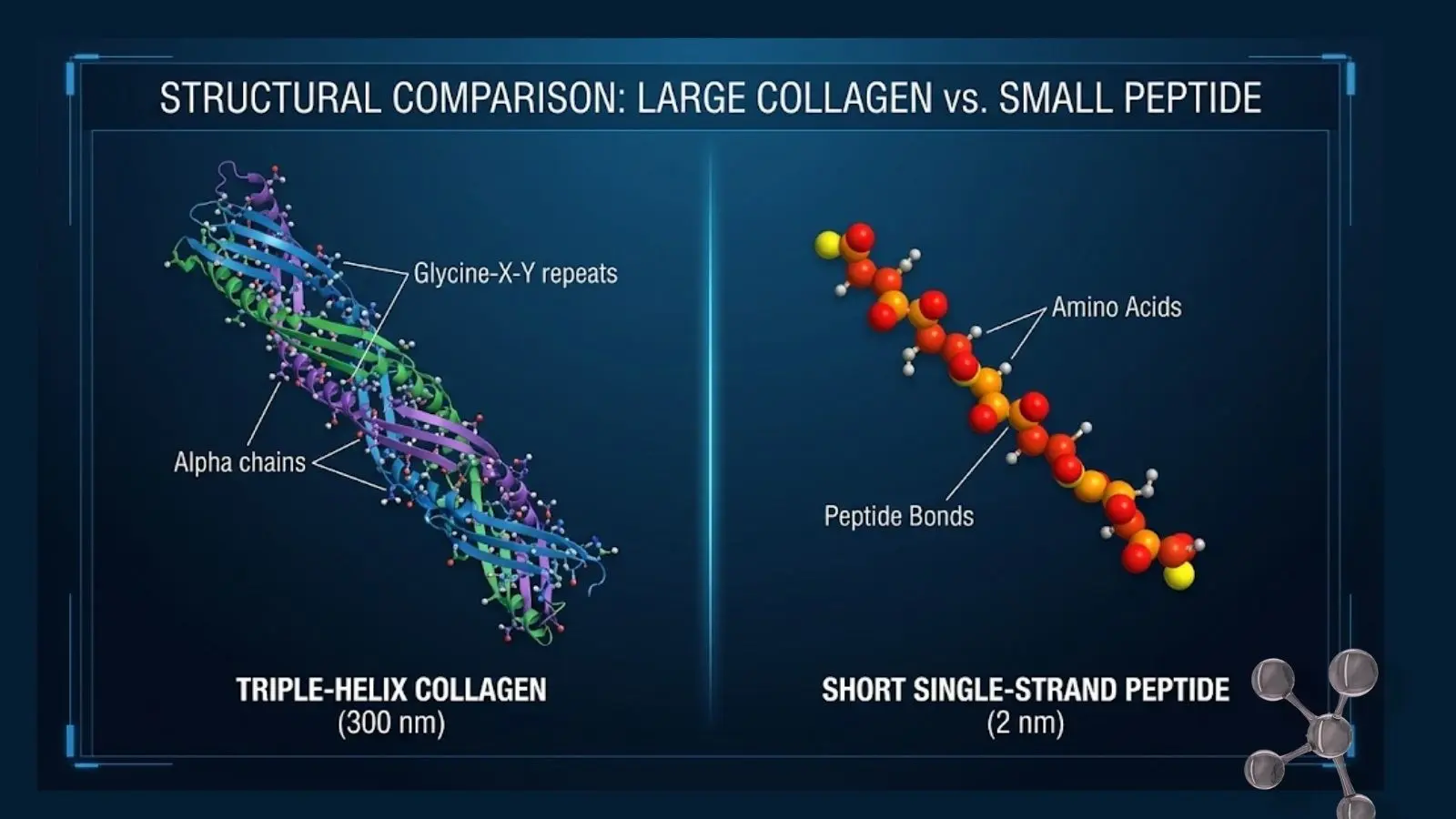
Collagen is the most abundant protein in the human body. It is the "glue" that holds you together, making up your skin, bones, tendons, and ligaments. In its natural state (like in a piece of steak, fish skin, or gristle), the collagen molecule is massive. It consists of three long chains twisted together into a rigid triple-helix structure.
Molecular Weight: Approximately 300,000 Daltons.
Absorbability: Poor. Your digestive system has to work very hard to break this down. -
The Peptide (The Fragment)
A "peptide" is simply a short chain of amino acids, usually containing fewer than 50 links. Think of the protein as a long, heavy beaded necklace, and the peptide as a short segment of that necklace that has been cut off.
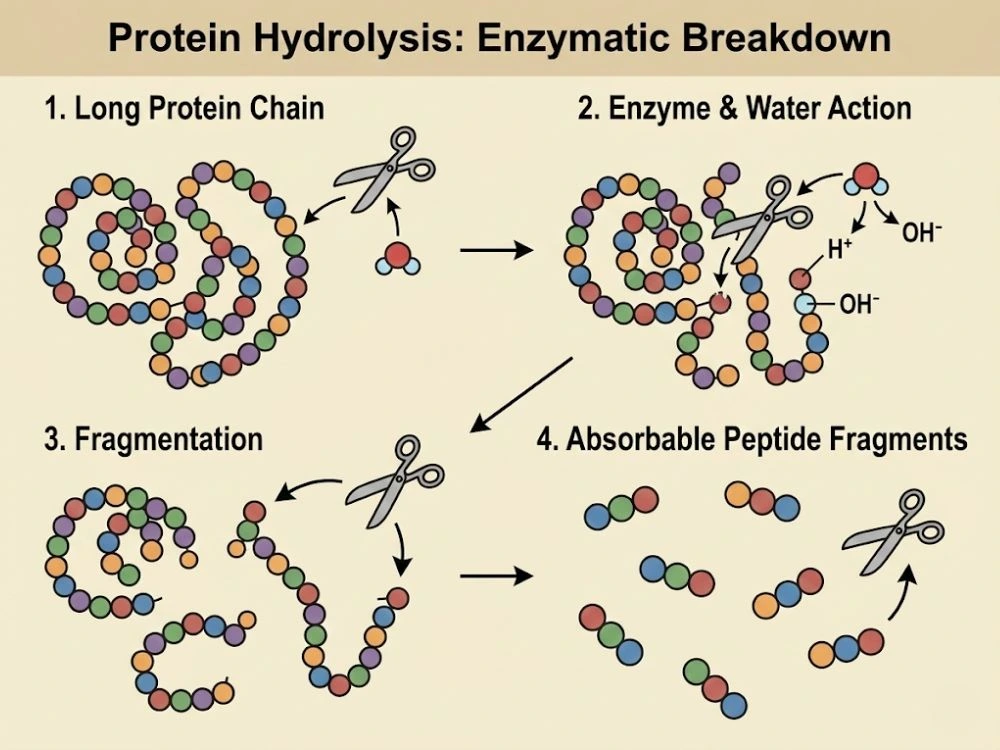
When supplement companies sell you "Collagen Peptides", they have taken that massive, indigestible collagen protein and put it through a process called enzymatic hydrolysis.
The Science of Hydrolysis: Why "Peptides" Work Better
The reason you buy "Collagen Peptides" instead of just eating gristle is bioavailability.
During the manufacturing process, enzymes act like molecular scissors. They chop the long, twisted collagen helix into tiny, single-strand fragments. These fragments usually have a molecular weight of less than 3,000 to 5,000 Daltons.
Why does this number matter? Because the lining of your gut acts like a sieve. Large molecules cannot pass through easily. Small, hydrolyzed peptide chains can slip through the intestinal wall and enter the bloodstream rapidly.
Internal Reference: For a deeper dive into the chemical structure of these chains, read our guide on Peptides and Polypeptides: Understanding the Molecular Differences.
Collagen Peptides vs. Bioactive Peptides: The Two Categories
Here is where the confusion truly lies. When people say "peptides" in the fitness or anti-aging world, they are usually talking about one of two very different categories.
Category A: Structural Peptides (Collagen)
These are the "Collagen Peptides" you see in big blue tubs at Costco.
- What they are: Structural building blocks.
- Amino Acid Profile: They are incredibly rich in three specific amino acids: Glycine, Proline, and Hydroxyproline.
- Primary Goal: To provide the raw material your body needs to rebuild tissue. When you ingest them, they act as "food" for your fibroblasts (skin cells) and chondrocytes (joint cells).
- Dosage: High (10 to 20 grams per day).
Category B: Signaling Peptides (Bioactive)
These are the "Research Peptides" sold in tiny vials (like BPC-157, GHK-Cu, or GLP-1).
- What they are: Biological messengers.
- Amino Acid Profile: These are highly specific sequences designed to unlock a cellular receptor.
- Primary Goal: To tell your cells what to do. These peptides do not build the wall; they tell the construction crew to start working.
- Dosage: Tiny (Micrograms or Milligrams).
Do You Need Both? The "Contractor vs. Lumber" Analogy
Yes, because they serve distinct roles in the repair process.
Think of building a house. Collagen peptides are the lumber, the bricks, and the cement. Signaling peptides are the general contractor shouting orders.
- If you have plenty of lumber (Collagen) but no contractor (Signaling), the workers sit around, and the house doesn't get built effectively.
- If you have a contractor yelling orders (Signaling) but no lumber (Collagen), the crew has nothing to build with.
The Synergistic Stack
Many biohackers and researchers use these two types together to maximize results:
- For Skin Health: Taking GHK-Cu (to signal regeneration and blood vessel growth) while taking Collagen Peptides (to provide the Glycine needed to build skin) is a powerful combination.
- For Injury Recovery: Using BPC-157 (to reduce inflammation and signal repair) alongside Collagen (to physically rebuild the tendon) accelerates recovery time.
Internal Reference: Learn more about the specific signaling power of GHK-Cu in GHK-Cu Copper Peptides: The Science of Skin Regeneration.
Clinical Evidence: What Does the Data Say?
The effectiveness of hydrolyzed collagen peptides is well-documented in clinical literature.
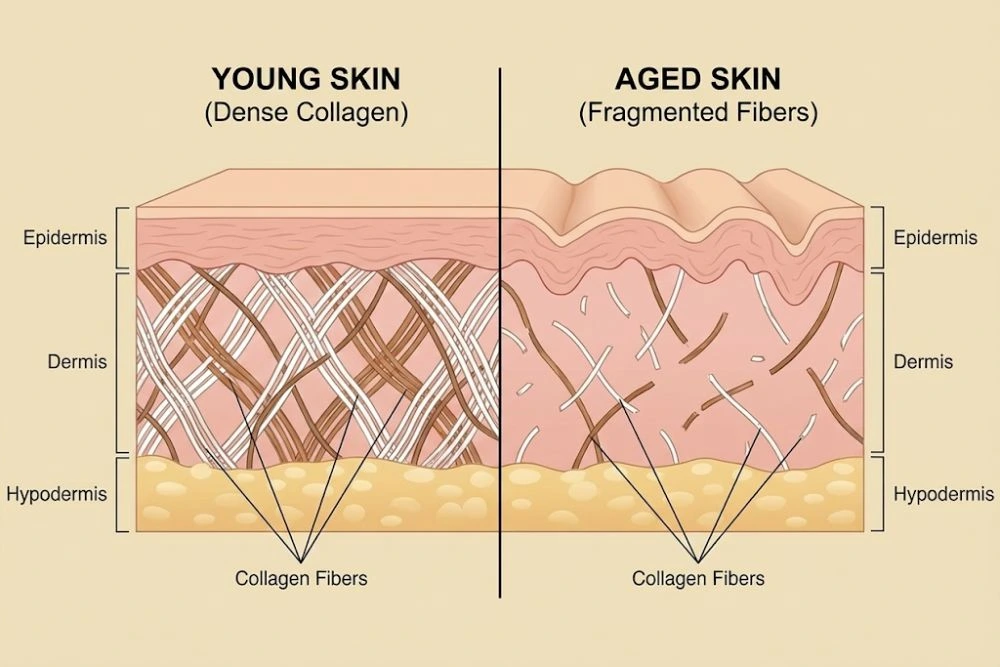
A study published in the Journal of Cosmetic Dermatology (PubMed) demonstrated that oral supplementation with collagen peptides significantly increased skin hydration and collagen density after just 8 weeks. The key finding was that the peptides (the hydrolyzed form) were effective where native proteins were not.
Another study in Nutrients highlighted that collagen peptides could improve joint functionality and reduce pain in athletes, proving that these amino acid chains do essentially "survive" digestion to exert a biological effect.
Common Misconceptions
Myth 1: "Bone Broth is the same as Collagen Peptides."
While bone broth contains collagen, it is not hydrolyzed. The molecules are larger and harder to absorb. You would need to drink massive amounts of broth to get the same amount of bioactive peptides found in one scoop of hydrolyzed powder.
Myth 2: "Vegan Collagen Peptides exist."
This is a marketing term. True collagen only comes from animals (cows, fish, chickens). Products labeled "Vegan Collagen" are usually just a mix of Vitamin C, silica, and amino acids designed to support your body's own production. They are not actual collagen peptides.
How to Read the Label
When shopping, pay strict attention to the wording to ensure you are buying the right tool for the job.
- If the label says "Hydrolyzed Collagen" or "Collagen Peptides," you are buying the structural building blocks. This is for general health, joints, and skin elasticity.
- If the label says "Copper Peptide Serum," "BPC-157," or "Growth Factor Peptides," you are buying a signaling agent. This is for targeted repair and specific biological outcomes.
Frequently Asked Questions
Conclusion
So, are collagen and peptides the same thing? Taxonomically, yes, collagen is a type of peptide. But functionally, they are worlds apart.
Collagen is the foundation. It keeps your skin firm, your bones strong, and your joints moving smoothly. Signaling Peptides are the managers, the messengers that tell your body when and where to heal. Understanding this distinction allows you to stack them effectively, ensuring your body has both the instructions and the materials it needs to thrive.
Official Medical Disclaimer
The information provided in this guide is for informational and educational purposes only. Peptides and GLP-1 research compounds are intended strictly for laboratory research and are not for human consumption or for the diagnosis, treatment, or prevention of any disease. All research should be conducted by qualified professionals in a controlled environment. The statements regarding these products have not been evaluated by the Food and Drug Administration (FDA). Always consult your local laws and institutional guidelines regarding the use of peptides in research. Always seek the advice of your physician or other qualified health provider with any questions you may have regarding a medical condition.