
Peptide Scientists: The Pioneers Who Transformed Modern Medicine
Meet the legendary peptide scientists who revolutionized medicine. From the discovery of insulin to GHK-Cu and BPC-157, explore the history of peptide science.
- Published
- Updated
- Reading time
- 6 min read
- Author
- By PeptidesFinder
On this page
The field of peptide science is not just a modern trend. It is the result of over a century of meticulous work by brilliant researchers. These individuals, often working in the face of skepticism, discovered the molecules that now define metabolic and regenerative health. When we look at the landscape of modern medicine, the influence of these peptide scientists is everywhere, from the management of diabetes to the cutting edge of tissue repair.
Understanding the history of these discoveries provides essential context for the research being conducted today. By looking at the lives and work of the most influential pioneers, we can see how a simple chain of amino acids became a cornerstone of human health and longevity.
The Foundation: Banting, Best, and the Miracle of Insulin
Every discussion about the most influential peptide scientists must begin in 1921 with Frederick Banting and Charles Best. Working at the University of Toronto, they were the first to successfully isolate insulin, a peptide hormone that would save millions of lives.
Before their work, a diagnosis of Type 1 diabetes was essentially a death sentence. Banting and Best discovered that by extracting this specific peptide from the pancreas, they could regulate blood sugar in patients who could no longer do so themselves. This discovery was so profound that it led to the 1923 Nobel Prize in Physiology or Medicine. You can read the historical perspective on this monumental achievement here: Therapeutic peptides: Historical perspectives.
Vincent du Vigneaud and the Synthesis of Oxytocin
In the 1950s, a researcher named Vincent du Vigneaud took peptide research a step further. While Banting and Best had isolated a natural peptide, du Vigneaud was the first scientist to achieve the total synthesis of a peptide hormone.
His work on oxytocin and vasopressin proved that peptides could be created in a laboratory setting while retaining their full biological activity. This breakthrough was the "proof of concept" that launched the multi-billion dollar peptide industry we see today. In 1955, du Vigneaud was awarded the Nobel Prize in Chemistry for his work, which paved the way for synthetic hormones and mimetic research.
Robert Merrifield: The Architect of Modern Synthesis
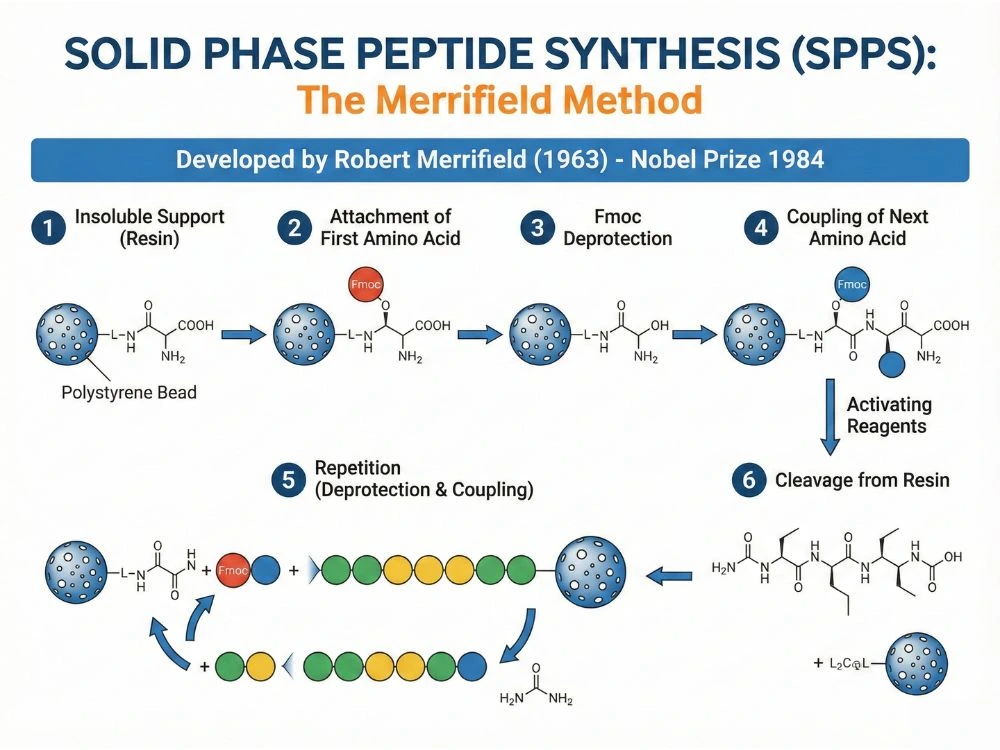
If Banting and du Vigneaud provided the molecules, Robert Bruce Merrifield provided the tools. In the late 1950s, Merrifield developed a process known as Solid Phase Peptide Synthesis (SPPS).
Before Merrifield, synthesizing even a short peptide was an agonizingly slow and inefficient process. His innovation allowed peptides to be built on an insoluble support, much like adding beads to a string. This made the production of research compounds faster, more accurate, and far more accessible to the scientific community. His work was so revolutionary that he received the Nobel Prize in Chemistry in 1984. You can explore the technical history of his invention here: Bruce Merrifield and solid-phase peptide synthesis.
Loren Pickart and the Discovery of GHK-Cu
In 1973, peptide scientists began looking more closely at the role of these molecules in the aging process. Dr. Loren Pickart was investigating why the blood of young individuals seemed to have a greater capacity for tissue repair than the blood of older individuals.
During his research, he isolated the tripeptide GHK-Cu (glycyl-L-histidyl-L-lysine copper). He discovered that this molecule could cause "old" liver cells to behave like "young" liver cells. Over the next four decades, Dr. Pickart's work revealed that GHK-Cu could modulate gene expression, stimulate collagen production, and protect the skin from UV radiation. His research is the primary reason why copper peptides are now a staple in both clinical and cosmetic research. A verified summary of his findings can be found here: The human tripeptide GHK-Cu in prevention of oxidative stress.
Predrag Sikiric and the BPC-157 Revolution
More recently, the focus of peptide science has shifted toward the "body protection compound" known as BPC-157. Dr. Predrag Sikiric and his team at the University of Zagreb have been the driving force behind this research for over 30 years.
Dr. Sikiric discovered that BPC-157, which is a fragment of a protein found in human gastric juice, has remarkable systemic healing properties. His studies have shown that it can promote the repair of tendons, muscles, ligaments, and even the central nervous system. His work is characterized by its focus on "cytoprotection," the process of protecting cells and blood vessels from damage. You can review the extensive research conducted by Dr. Sikiric and his colleagues here: Stable gastric pentadecapeptide BPC 157: novel therapy.
The Modern Era: Precision and Accuracy
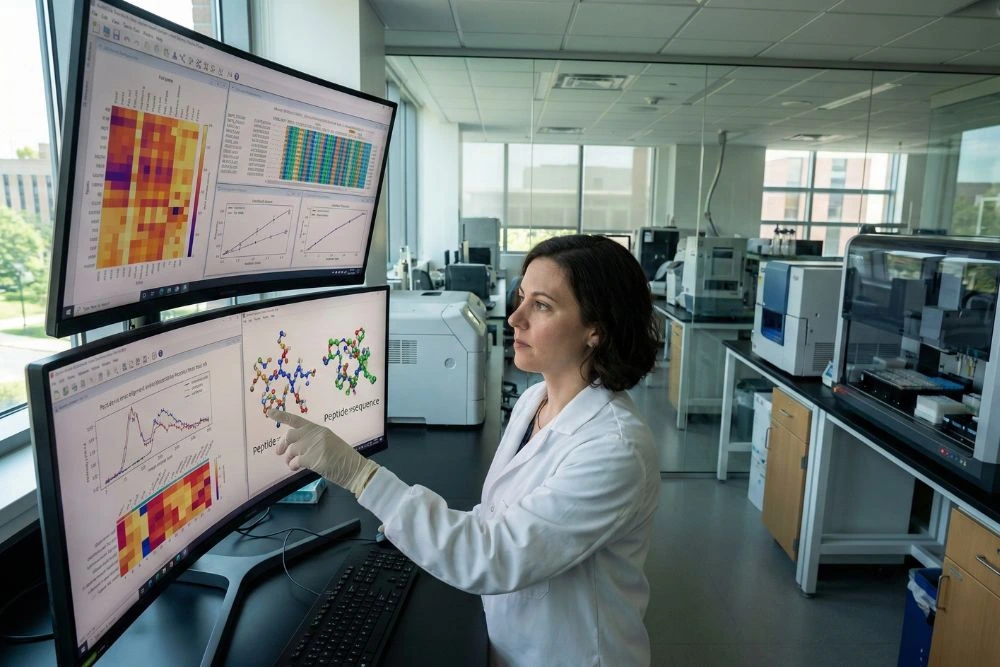
As we move deeper into 2026, the work of these pioneers is being continued by a new generation of researchers. The focus has moved from simple isolation to extreme precision. Today, researchers utilize advanced tools to ensure that their findings are reproducible and safe.
One of the most critical aspects of modern research is the accuracy of reconstitution. Because research compounds are typically delivered in a dry, powder form, the ratio of bacteriostatic water to peptide must be perfect. To assist in this, many labs now utilize a Peptide Calculator to remove the possibility of human error in their mathematical equations. This level of precision is exactly what the early pioneers would have hoped for as their work evolved.
Conclusion: Standing on the Shoulders of Giants
The history of peptide science is a story of persistence. Whether it was Banting working in a sweltering laboratory in Toronto or Dr. Pickart spending decades on a single tripeptide, the progress we see today is built on their dedication. As researchers continue to explore the potential of these molecules for cognitive health, metabolic optimization, and tissue repair, they are standing on the shoulders of the giants who came before them.
For those looking for a comprehensive list of resources and vetted providers, the Peptides Finder Directory serves as a valuable starting point to find third party tested materials.
Frequently Asked Questions
Official Medical Disclaimer
The information provided in this guide is for informational and educational purposes only. Peptides and GLP-1 research compounds are intended strictly for laboratory research and are not for human consumption or for the diagnosis, treatment, or prevention of any disease. All research should be conducted by qualified professionals in a controlled environment. The statements regarding these products have not been evaluated by the Food and Drug Administration (FDA). Always consult your local laws and institutional guidelines regarding the use of peptides in research. Always seek the advice of your physician or other qualified health provider with any questions you may have regarding a medical condition.